
5G Japan 2026: Coverage, Speeds, and What Travelers Actually Experience
Japan’s 5G story is one of the most ambitious infrastructure narratives in modern telecommunications — a country that built the world’s most reliable 4G network and then committed to surpassing it. Since its commercial 5G launch in 2020, Japan has progressively deployed fifth-generation mobile infrastructure across a geography that presents genuine engineering challenges: mountainous terrain, extreme urban density, and a population distribution that concentrates most users in a relatively small proportion of the total landmass.
For international travelers, understanding 5G Japan 2026 coverage is both practically useful and contextually interesting. Practically: knowing whether your destination has 5G coverage and whether your device can access it determines the connectivity tier your Japan eSIM plan delivers. Contextually: Japan’s approach to 5G reflects the same infrastructure-first philosophy that made its 4G network the envy of most developed countries — and the results are increasingly visible in the speed, responsiveness, and capacity of mobile connectivity across Japan’s major cities.
This guide covers Japan’s 5G launch history, the current coverage footprint across major and regional cities, the reality of rural 5G availability, the speeds tourists actually experience, which phones access Japan 5G, and where Japan’s network technology is heading next. Whether you’re a tech-focused traveler optimizing your Japan connectivity setup or simply curious about what your 5G-capable device will actually deliver on a Docomo, SoftBank, or KDDI plan, here’s the complete picture.
When 5G Launched in Japan
Japan’s three major carriers launched commercial 5G services in March 2020 — a nearly simultaneous rollout that reflected the competitive dynamics of Japan’s mobile market, where no carrier wanted to be seen trailing in technology deployment.
The March 2020 Launch
NTT Docomo, SoftBank, and KDDI/au all announced commercial 5G service within days of each other in late March 2020. The timing was unfortunate in one respect — the COVID-19 pandemic that began simultaneously suppressed the initial consumer demand that would have showcased 5G’s capabilities. International visitors, who would have been a visible early 5G use case in Japan’s tourist-heavy major cities, were effectively absent from Japan’s market for nearly three years following the launch.
This compressed initial demand cycle had an unintended structural benefit: Japanese carriers were able to conduct 5G infrastructure expansion during a period of reduced network load, laying the groundwork for a more mature and capable network by the time international tourism fully resumed in late 2022 and 2023.
5G Spectrum in Japan
Japan’s 5G networks operate primarily on Sub-6GHz spectrum — the frequencies that balance coverage range and speed for national deployment:
- Band n77 (3.7 GHz): Primary 5G band used by all three carriers; main urban coverage layer
- Band n78 (3.5 GHz): Deployed by all three carriers for additional urban capacity
- Band n28 (700 MHz): Lower-frequency 5G deployed by KDDI and SoftBank for wider-area coverage; better building penetration and range than n77/n78
- Band n257 (28 GHz — mmWave): Very high speed, very short range; deployed in specific high-density venues by all three carriers
The Sub-6GHz focus distinguishes Japan’s 5G deployment from the early US strategy that emphasized mmWave (producing spectacular speed claims in very small coverage zones). Japan’s Sub-6GHz first approach produces real-world 5G coverage that actually reaches users consistently rather than being concentrated in a few outdoor locations per city block.
Major Cities With Full 5G Coverage
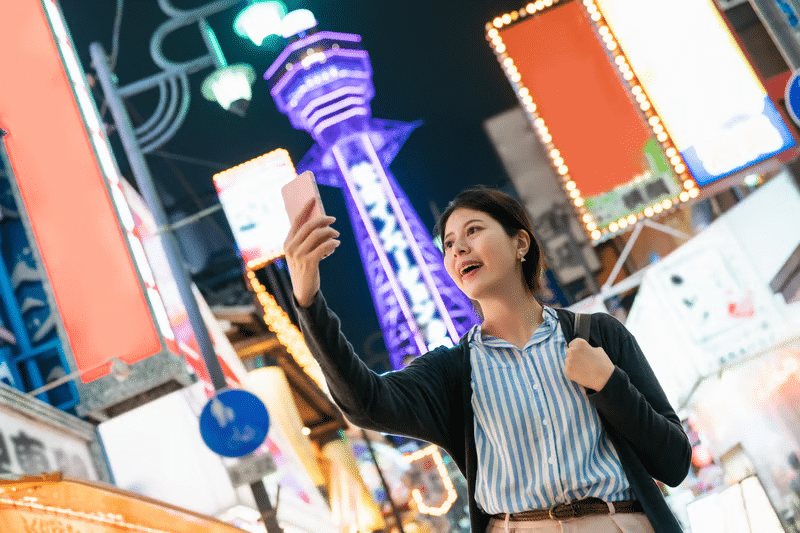
Japan 5g cities with comprehensive Sub-6GHz coverage in 2026 includes every major population center and is progressively expanding into the broader metropolitan zones surrounding them.
Tokyo
Japan 5g tokyo coverage from all three carriers blankets central Tokyo’s 23 wards with Sub-6GHz 5G, with strongest deployment in the highest-density commercial and entertainment districts: Shinjuku, Shibuya, Marunouchi, Ginza, Akihabara, Roppongi, and Odaiba. 5G coverage extends into the inner suburban wards and is progressively expanding into the greater Tokyo metropolitan area — Yokohama, Kawasaki, Saitama, and Chiba all have meaningful 5G presence from multiple carriers.
Tokyo’s subway system is progressively receiving 5G coverage in station areas, building on the existing 4G in-station infrastructure through Japan’s carrier sharing agreements.
Osaka
Japan 5g osaka deployment covers the central Osaka commercial and tourist core — Namba, Shinsaibashi, Dotonbori, Umeda, and the business districts of Honmachi and Yodoyabashi — with Sub-6GHz 5G from all three carriers. The greater Keihanshin metropolitan area (Osaka–Kobe–Kyoto) is actively expanding 5G coverage, with Kyoto’s central tourist districts and Kobe’s Sannomiya commercial hub both receiving 5G infrastructure investment.
Nagoya
Japan’s third-largest city has comprehensive 5G coverage in the central business district, Sakae entertainment area, and the Nagoya Station corridor — Japan’s most expensive real estate market by land value and a major driver of network investment. KDDI’s historical infrastructure strength in the Chubu region is reflected in particularly competitive au 5G performance in Nagoya and surrounding Aichi Prefecture.
Other Major Cities With Full 5G
- Fukuoka: Full central city 5G coverage from all three carriers; Japan’s gateway to Korea and Southeast Asia has prioritized connectivity infrastructure
- Sapporo: Comprehensive central district 5G; Hokkaido’s capital and Japan’s northernmost major city
- Sendai: Full urban core 5G from major carriers; Tohoku’s regional center
- Hiroshima: Complete central city coverage; growing as a tourist destination and international conference venue
- Kobe: Strong 5G in commercial and tourist districts; benefits from Keihanshin region investment
- Kyoto: Central tourist areas and commercial districts covered; expanding progressively into cultural heritage zones
Regional Cities With Partial 5G Coverage
Japan’s regional cities — the prefectural capitals and mid-size cities that carry enormous cultural significance and increasing tourist traffic — have 5G coverage in their central areas with ongoing expansion into surrounding zones.
Current Partial 5G Coverage Pattern
The typical pattern for japan 5g cities at the regional level: central commercial district and major transit hub have 5G coverage, while residential outer areas and the rural-urban fringe remain primarily on 4G LTE. For tourists visiting regional cities, this means 5G connectivity is generally available in the areas they’re most likely to spend time — around the main station, in the historic center, and at major tourist attractions — while outlying areas default to LTE.
Kanazawa: 5G in central commercial areas including around Kanazawa Station. The Higashi Chaya historic district and Kenroku-en garden surroundings have selective coverage — sufficient for tourist use in the main visiting areas.
Matsumoto: Central city 5G from KDDI and Docomo in the station area and historic core, with LTE covering the surrounding alpine approaches.
Takamatsu: Shikoku’s main hub has growing 5G coverage reflecting the island’s development as a tourist destination, particularly around the Ritsurin Garden and the art island ferry terminals.
Naha (Okinawa): Central Naha including the Kokusai-dori shopping street and port areas carry 5G coverage; outlying Okinawa main island areas are primarily LTE.
Hakodate, Aomori, Akita, Yamagata, Morioka: These Tohoku and Hokkaido regional cities have 5G in central areas with LTE coverage dominating surrounding zones.
Rural Areas and the 5G Gap
Japan 5g rural deployment is the starkest infrastructure gap in Japan’s otherwise world-class mobile network landscape — and the honest assessment matters for travelers planning itineraries in Japan’s countryside.
The Current Rural Reality
Outside Japan’s urban and suburban zones, 5G coverage is absent in most rural areas. Japan’s rural 5G gap is not a failure of ambition — it’s an economic and engineering reality that applies globally. 5G’s primary Sub-6GHz bands require denser tower spacing than 4G LTE’s lower-frequency bands to achieve equivalent geographic coverage, making rural 5G deployment significantly more expensive per square kilometer than urban 5G.
Japan’s carriers are addressing this gap through two approaches: Band n28 (700 MHz) 5G deployment by KDDI and SoftBank, which travels farther from each tower and penetrates terrain more effectively than n77/n78; and the “5G SA” (Standalone Architecture) deployments that some carriers are beginning in rural contexts as infrastructure investment cycles extend the technology outward from cities.
What Rural Japan Actually Has
For japan 5g rural travelers, the practical situation is this: rural Japan in 2026 has excellent 4G LTE coverage (particularly on Docomo’s Band 19 infrastructure) that delivers fast, reliable connectivity for every standard travel application. The absence of 5G in rural Japan means slower peak speeds compared to urban 5G zones — but Japan’s LTE speeds (typically 20–80 Mbps downstream in rural areas) are genuinely fast by global standards and more than sufficient for navigation, translation, streaming, and communication.
The japan 5g vs 4g distinction matters most for specific high-bandwidth applications: 4K video streaming, large file transfers, and real-time cloud processing. For the vast majority of Japan travel use cases, LTE delivers indistinguishable performance from 5G in practical terms.
5G Speeds Tourists Actually Experience
Japan 5g speed claims from carriers — theoretical maximums measured in ideal laboratory conditions — are rarely what users experience in real-world environments. Understanding the realistic speed range for japan tourist 5g use calibrates expectations accurately.
Real-World 5G Speed Ranges in Japan
Sub-6GHz 5G in uncongested urban areas (typical tourist experience):
- Downstream: 150–600 Mbps
- Upstream: 30–100 Mbps
- Latency: 10–30 ms
Sub-6GHz 5G in congested peak-period locations (major tourist sites, transit hubs at rush hour):
- Downstream: 50–200 Mbps
- Upstream: 15–50 Mbps
- Latency: 20–50 ms
mmWave 5G in specific deployment zones (major train stations, stadiums):
- Downstream: 1,000–3,000 Mbps (1–3 Gbps)
- Upstream: 100–500 Mbps
- Latency: 5–15 ms
- Coverage zone: typically within 100–200 meters of mmWave antennas
4G LTE in urban Japan (comparison baseline):
- Downstream: 30–150 Mbps
- Upstream: 10–30 Mbps
- Latency: 20–50 ms
What These Speeds Mean for Tourists
For the japan tourist 5g experience in practical terms:
- Maps and navigation: Instantaneous on both 5G and LTE — the tile loading speed difference is imperceptible in normal use
- Translation apps: Real-time camera translation requires minimal bandwidth; both 5G and LTE handle it without delay
- Video streaming: 4K HDR streaming requires approximately 25 Mbps — achievable on both 5G and a strong LTE connection
- Video calls: High-quality video calls require 5–10 Mbps — comfortably within LTE range; 5G adds margin for stability in congested areas
- Photo uploads: A 50 MB burst upload from a day of photography takes approximately 4 seconds on strong 5G, 15–30 seconds on good LTE
The honest assessment: 5G provides meaningful speed benefits for bandwidth-intensive tasks and noticeably improved performance in congested tourist peak periods. For everyday Japan travel connectivity, LTE remains fully capable and 5G is a welcome upgrade rather than a necessity.
Phones That Take Advantage of Japan 5G
Not all eSIM-capable phones access Japan’s 5G network — the device must include the specific radio hardware for Japan’s deployed 5G bands.
Japan 5g iphone: Compatible Models
5G-capable iPhones that access Japan’s Sub-6GHz 5G (n77, n78):
- iPhone 12 series and later (all variants support Sub-6GHz 5G)
- iPhone 13 series and later
- iPhone 14 series and later
- iPhone 15 series and later
- iPhone 16 series and later
- iPhone 17 series and later
- iPhone SE 3rd generation (2022) and later
iPhone XS, XR, and iPhone 11 series are 4G LTE only — no 5G hardware regardless of plan or network.
Japan 5g android: Compatible Models
Japan 5g android compatibility is broad across current flagship and mid-range devices:
- Samsung: Galaxy S21 series and later, Z Fold3 and later, Z Flip3 and later, Galaxy A54/A55/A56 in international variants
- Google Pixel: Pixel 5 and later (all variants), all Pixel A series from Pixel 5a onward
- Other Android brands: Most current flagship devices from Sony, Motorola, OnePlus, and others support n77/n78 in international variants — verify band specifications for your specific model
The Japan 5g phone Band Verification
The critical check for Japan 5G access: does your device support Band n77 (3.7 GHz) or Band n78 (3.5 GHz)? These are Japan’s primary 5G bands, deployed by all three carriers. Find your device’s band specifications at the manufacturer’s product page or via the GSMArena database — search your exact model number and check “Network” → “Technology” → “5G bands.”
A japan 5g esim plan from Japan Sim Data on Docomo, SoftBank, or KDDI will deliver 5G speeds to compatible devices automatically — no additional configuration required beyond normal eSIM setup.
The Future of 5G and 6G in Japan
The japan 5g future trajectory reflects Japan’s consistent pattern of investing ahead of demand to build infrastructure that shapes travel and commercial experience for the next decade.
5G Expansion Through 2026 and Beyond
All three major carriers have committed to significant 5G coverage expansion through 2026 and into the late 2020s:
- Docomo: Targeting 90%+ of Japan’s populated areas for 5G coverage by 2027, with Band n28 low-frequency 5G playing an increasing role in suburban and rural expansion
- SoftBank: Continuing aggressive urban 5G densification and expanding suburban coverage through Band n28 deployment
- KDDI: Municipal partnership model extending 5G into regional cities ahead of purely commercial deployment timelines
The docomo 5g, softbank 5g, and kddi 5g expansion programs collectively represent billions of dollars in annual infrastructure investment — a scale of commitment that reflects the Japanese government’s stated goal of maintaining Japan’s position as a global mobile technology leader.
6G: Japan’s Next Frontier
Japan has positioned itself as one of the world’s most active 6G research and development participants. The Japanese government’s 6G promotion program, announced in 2021 and actively funded through 2025, targets commercial 6G deployment around 2030. NTT has published 6G architecture specifications and conducted prototype demonstrations; KDDI and SoftBank have both established 6G research partnerships with international technology companies.
For travelers, 6G’s practical implications are a decade away — but Japan’s 6G investment reflects the same infrastructure-forward philosophy that produced the 4G network travelers enjoy today and the 5G network that is progressively transforming urban Japan connectivity. The country that built the world’s most reliable 4G network is not planning to stop at 5G.
According to the Japan Tourism Agency, digital infrastructure development is explicitly listed among Japan’s inbound tourism enhancement priorities — recognizing that connectivity quality directly affects international visitor experience and Japan’s competitiveness as a destination. The GSMA’s Mobile Economy Japan report provides detailed 5G investment and coverage data confirming Japan’s position among the world’s leading 5G markets by deployment completeness and speed performance.
Japan Sim Data’s 5G-enabled eSIM plans on Docomo, SoftBank, and KDDI deliver Sub-6GHz 5G access to compatible devices across Japan’s covered urban areas — with the same plan working on 4G LTE in rural and suburban zones where 5G coverage is still expanding.
Conclusion

5G Japan 2026 is a network that delivers on its infrastructure investment in Japan’s major cities while honestly acknowledging the gap that remains in rural areas. For urban and mixed itinerary travelers with 5G-capable devices, Japan’s 5G networks in Tokyo, Osaka, Nagoya, Fukuoka, and the country’s regional city cores offer some of the fastest and most consistent mobile speeds available anywhere in the world. For rural Japan explorers, Japan’s 4G LTE remains a world-class fallback — fast, reliable, and more than capable of handling every travel connectivity need.
The japan 5g map is expanding meaningfully each year. Travelers visiting Japan in 2026 with current-generation 5G phones and a Japan eSIM from Japan Sim Data on Docomo, SoftBank, or KDDI will experience the full benefit of that expansion in every urban and suburban zone they visit — and seamlessly transition to LTE without any interruption in coverage as their itinerary takes them into Japan’s extraordinary countryside.
Japan’s mobile infrastructure is not a feature of the trip — it’s the invisible layer that makes the trip possible. Explore Japan Sim Data’s 5G-enabled eSIM plans on all three major networks and travel with connectivity that matches Japan’s extraordinary ambition.
Frequently Asked Questions
Q1: Do I need a 5G phone for Japan, or is 4G LTE enough? A: 4G LTE is fully sufficient for every standard Japan travel use case — navigation, translation, booking apps, messaging, video calls, and streaming all work without any speed limitation on Japan’s LTE network. A 5G phone delivers faster speeds in covered urban areas and better performance during peak congestion at major tourist sites, but upgrading to a 5G device specifically for Japan travel is not necessary. Japan’s LTE network is among the world’s fastest and most reliable — it’s an excellent primary connection without 5G.
Q2: Which Japanese carrier has the best 5G coverage in Tokyo? A: All three carriers — Docomo, SoftBank, and KDDI — provide comprehensive Sub-6GHz 5G coverage in central Tokyo. Independent speed tests in 2025–2026 consistently show SoftBank with the fastest peak 5G speeds in the densest urban zones, while Docomo and KDDI deliver competitive performance with broader geographic consistency. For most tourist applications in Tokyo, the practical difference between carriers’ 5G performance is minimal — all three deliver speeds far in excess of what standard travel apps require.
Q3: Will my Japan eSIM automatically use 5G if available? A: Yes, on compatible devices. When your Japan eSIM on a Docomo, SoftBank, or KDDI plan is active and your device enters a 5G coverage zone, it switches from 4G LTE to 5G automatically — no manual configuration required. Your device’s network indicator will show “5G” (or “5G+” for certain high-performance 5G zones) when connected. If you prefer to restrict to LTE for battery conservation, this can be set in your device’s network mode settings (Settings → Cellular → Voice & Data on iPhone; Settings → Network & Internet → SIMs → Preferred network type on Android).
Q4: Is Japan’s 5G better than 5G in the United States or Europe? A: Japan’s 5G compares favorably to most major markets in coverage consistency and real-world speed delivery. Japan’s Sub-6GHz first approach produces 5G coverage that users actually encounter in daily mobility, unlike early US mmWave deployments that produced impressive speed measurements in very limited geographic zones. European 5G in major cities is comparable to Japan’s; Japan’s advantage is network reliability and the carrier infrastructure investment intensity that has characterized Japan’s mobile market across all generations.
Q5: When will Japan’s rural areas have 5G coverage? A: Meaningful rural 5G coverage is a late-2020s target for Japan’s carriers, with Band n28 (700 MHz) low-frequency 5G playing an increasing role in expanding coverage into suburban and eventually rural areas. Docomo’s 5G rural expansion timeline targets 90%+ of populated areas by 2027, which includes many areas currently on LTE-only coverage. Japan’s mountainous geography means complete rural 5G coverage will take longer than flat-terrain countries — but the trajectory is clear and investment is committed.