

eSIM for Rural Japan: Best Networks for Countryside Travel

Japan’s inaka — the countryside, literally “the place with rice fields” — is one of the country’s most honest and least mediated travel experiences. Away from the concentrated tourist infrastructure of Tokyo, Kyoto, and Osaka, rural Japan offers encounters with the country as it actually lives: the elderly farmer who stops to talk in a language barrier-free exchange of smiles and gestures, the farmhouse guesthouse where dinner is the family’s own vegetables prepared in regional style, the hot spring that is genuinely local rather than resort-managed, the small shrine on a hillside that has never appeared in a travel article and never needs to.
The rural Japan eSIM question is the most practically consequential connectivity question in Japan travel — more so than the Tokyo neighborhood guide or the Kansai city connectivity assessment, where the answer is always “any carrier works excellently.” In rural Japan, the carrier you choose determines not just the quality of your connectivity but whether you have connectivity at all in specific locations. This is not a minor distinction for a solo traveler navigating an unmarked mountain road to reach a remote farmstay that doesn’t have WiFi.
This guide addresses the rural Japan connectivity reality honestly and specifically: how the three carriers actually compare in the countryside, what farmstays and remote onsen mean for connectivity planning, how to manage data when WiFi is absent or unreliable for extended periods, which Japanese regions have the weakest and strongest rural coverage, and which Japan Sim Data plan configuration gives countryside travelers the foundation they need to explore rural Japan with confidence.
Connectivity Realities in Rural Japan

The Inaka Coverage Gap
Japan’s mobile network infrastructure is among the world’s finest in aggregate — but that aggregate excellence is distributed very unevenly between urban and rural Japan. Japan’s carriers have built their networks to serve Japan’s population, and Japan’s population is extraordinarily concentrated in urban areas. The greater Tokyo metropolitan area contains about 37 million people — more than a quarter of Japan’s total population — in a relatively small geographic footprint. The vast rural landscapes of Hokkaido, Tohoku, the Chugoku mountains, and the Kii Peninsula contain a tiny fraction of that population across much larger areas.
The result is a coverage map that is excellent in the cities and along the Shinkansen corridors, and progressively thinner as you move away from population centers into the agricultural plains, mountain valleys, and coastal fishing villages that constitute rural Japan’s landscape.
What “Variable Coverage” Actually Means
When connectivity guides describe rural Japan coverage as “variable,” this means different things in different contexts:
On main national roads (国道): Coverage is generally adequate on Docomo, passing through towns and maintained along the main routes connecting them. Brief coverage gaps occur in specific valley and tunnel sections.
On secondary prefectural roads (県道): Coverage becomes intermittent — present in populated sections, absent between settlements, and completely unreliable on mountain and coastal sections that serve small communities.
On mountain trails and forest roads: Coverage is the exception rather than the rule, concentrated in starting point areas and specific ridge or summit locations where line-of-sight to distant towers exists.
At farmstays and remote onsen: Coverage depends entirely on the specific location. A farmstay in a populated rural valley may have adequate Docomo signal; a remote onsen in a deep mountain gorge may have no signal from any carrier.
How Docomo, SoftBank, and KDDI Compare in the Countryside
Docomo Rural Coverage: The Clear Leader
docomo rural coverage is the consistent basis for every rural Japan recommendation in this guide series, and the evidence for this recommendation is both quantitative and practical. Docomo maintains the largest number of base stations in Japan, with particular emphasis on rural coverage that reflects its position as Japan’s incumbent national carrier with infrastructure obligations across the full national territory.
In practical terms, this means:
- On national roads between rural towns, Docomo maintains signal more consistently than other carriers
- In mountain villages and remote farmhouse areas, Docomo reaches locations where SoftBank and KDDI have no signal
- On the approach roads to remote onsen, national park trailheads, and agricultural areas, Docomo signal is present further from population centers than other carriers
For the farmstay japan internet and minshuku mobile data questions specifically: a farmstay that sits within any carrier’s coverage will have Docomo coverage. A farmstay that sits at the edge of coverage zones may have Docomo signal and not SoftBank or KDDI.
SoftBank Rural Japan: Strong Urban, Thinner Rural
softbank rural japan coverage is the most urban-optimized of the three carriers’ rural performance profiles. SoftBank has built excellent coverage in Japan’s cities and suburban areas, with progressively less coverage investment in the rural areas that its urban-focused subscriber base uses less frequently.
In practical terms for rural travel: SoftBank provides adequate coverage in rural market towns and accessible tourist areas. It becomes less reliable in the secondary and tertiary road networks between towns, in mountain and gorge environments, and in the genuinely remote villages and farmhouse areas that constitute deep rural Japan.
SoftBank is not a poor choice for rural Japan — it is an appropriate choice for travelers whose “rural Japan” experience is concentrated in accessible tourist areas, small onsen towns with tourism infrastructure, and the main roads connecting them. It is not the right choice for travelers whose rural Japan experience involves genuinely off-the-beaten-path exploration.
KDDI Rural Japan: Mid-Range Performance
kddi rural japan coverage sits between Docomo and SoftBank in rural depth. KDDI has made significant network expansion in recent years, and its rural coverage in specific regions (particularly in Kyushu and parts of the Chugoku region) has improved relative to its historical performance. In aggregate, however, KDDI’s rural coverage is less comprehensive than Docomo’s across Japan’s countryside, and the recommendation for deep rural travel remains Docomo.
eSIM Tips for Farmstays, Minshuku, and Remote Onsen
Farmstay Japan Internet Reality
The farmstay japan internet situation reflects the enormous diversity of rural accommodation in Japan. Some modern rural guesthouses — particularly those that have invested in tourism infrastructure and serve international visitors regularly — provide WiFi of reasonable quality. Traditional farmhouses (kominka), agricultural homestays, and working farm accommodations may have no WiFi, slow WiFi, or WiFi that is nominal rather than functional.
For farmstay connectivity planning:
Research before booking: Many Japanese farmstay booking platforms (Satoyama Experience, INAKADATE, regional tourism boards) indicate WiFi availability. Where this information is not clear, email or message the host before booking to understand the connectivity situation.
Treat WiFi as supplementary, eSIM as primary: The rural Japan traveler who relies on farmstay WiFi as their primary connectivity source will experience connectivity uncertainty. The traveler with Docomo eSIM as primary connectivity treats any available farmstay WiFi as a welcome bonus for large downloads rather than a baseline expectation.
The coverage-first accommodation decision: For solo travelers or travelers with specific connectivity requirements, the Docomo signal availability at a potential farmstay is a legitimate factor in accommodation selection. Japan’s coverage maps are available through each carrier’s website and can be used to check specific rural address coverage before booking.
Minshuku Mobile Data
minshuku mobile data planning covers Japan’s traditional family-run guesthouses — the rural accommodation category that sits between expensive ryokan and budget camping, offering home-cooked meals, tatami rooms, and genuine local hospitality. Minshuku in rural areas may or may not have WiFi, and the WiFi quality where available varies considerably.
The minshuku experience — arriving to the smell of dinner cooking, the elderly innkeeper’s slightly formal welcome, the sake served with the evening’s fish — is one of rural Japan’s great accommodations. Connectivity at minshuku should be treated realistically: Docomo signal in the village where the minshuku sits, with the understanding that specific locations may have no signal from any carrier.
Remote Onsen Connectivity
Japan esim onsen connectivity at the most famous remote hot spring destinations reflects the full spectrum of rural coverage reality. Some celebrated remote onsen are more accessible than their reputation suggests — Nyūtō Onsen in Akita, for example, has Docomo coverage in the ryokan compound areas. Others are genuinely in deep mountain environments where connectivity is absent from all carriers — the Tsurunoyu Onsen’s most remote outdoor bath, for example, is a full offline experience.
The remote onsen connectivity planning approach: research the specific onsen destination’s coverage through Docomo’s coverage map, download offline entertainment and reading material before departing for the onsen stay, and treat the offline experience as one of the genuinely restorative aspects of a remote hot spring retreat.
Data Planning Without Reliable WiFi

The japan esim remote Data Strategy
The countryside data plan japan approach for rural itineraries without reliable WiFi access requires a different mindset from urban Japan data planning. The urban traveler’s assumption — that hotel WiFi will be available for large downloads in the evening — cannot be made for rural Japan accommodation.
Pre-trip download strategy: Before departing for rural Japan from any city accommodation or transportation hub, complete all large downloads: offline map tiles for the full rural route, Google Translate’s Japanese language pack for offline camera translation, entertainment content (podcasts, downloaded videos, e-books), and any research documents or booking confirmations that may need to be referenced offline.
Daily data budget awareness: Without evening WiFi to reset the large-download burden onto, rural Japan travelers should be more conscious of daily data consumption than urban Japan travelers. Navigation (offline tiles supplemented by real-time data for live traffic and points of interest), translation, and communication are the essential daily data uses. Streaming video and large photo uploads are best deferred to any available WiFi opportunity.
Identify WiFi opportunities en route: Convenience stores (7-Eleven, Lawson, FamilyMart) in rural Japan provide free WiFi even in relatively small towns. These are the natural stops for large uploads during a rural road trip — pull into the convenience store parking lot, use the WiFi for large data tasks, and continue. The kombini WiFi strategy for rural Japan travelers is one of the most practical connectivity management approaches available.
Offline Maps Are Non-Negotiable
The japan esim inaka traveler who attempts to navigate rural Japan with real-time map data only — no offline tiles downloaded — is taking an unnecessary risk. Rural Japan road signage is often Japanese-only, junction decisions can be irreversible on narrow mountain roads, and the moment connectivity drops (which it will, on secondary roads between rural towns) is exactly the moment when navigation is needed.
Download Google Maps or Maps.me offline tiles for every prefecture and region your rural itinerary will cover before departing from the last reliable WiFi or data connection before the rural section begins.
Regions with the Weakest and Strongest Rural Coverage
Strong Rural Coverage
Kagawa Prefecture (Shikoku): The smallest and most densely populated Shikoku prefecture has the strongest rural coverage of any Shikoku region — even small island and coastal areas have reasonable Docomo signal.
Nagano Prefecture valleys: The valley floor settlements of the Japan Alps have reasonable Docomo coverage, reflecting the tourism and agricultural development that has driven infrastructure investment.
Noto Peninsula (Ishikawa): Better coverage than its remote character suggests, particularly on the main peninsula road circuit.
Variable Rural Coverage
Iwate and Akita (Tohoku interior): Main valleys and town areas are covered; mountain and forest interior sections are variable. Docomo covers significantly more of this terrain than other carriers.
Gifu Prefecture rural (Shirakawa-go surrounds): The UNESCO gasshō-zukuri village of Shirakawa-go is covered; the mountain roads surrounding it are variable.
Weakest Rural Coverage
Shiretoko Peninsula (Hokkaido): Beyond the main visitor area, coverage is absent from all carriers.
Iriomote-jima interior (Okinawa): The jungle interior of Japan’s largest subtropical island is beyond coverage for all carriers.
Remote Kii Peninsula mountain areas (Wakayama): The deepest sections of the Kumano Kodo pilgrimage routes move through terrain with no reliable signal from any carrier.
Deep Shikoku Mountains: The interior sections of the 88-temple walking pilgrimage in the mountain passes of Kochi and Ehime prefectures can be beyond coverage even on Docomo.
Best Japan Sim Data Plans for Countryside Trips
Network Recommendation: Docomo Without Qualification
For any rural Japan esim purchase, Docomo is the network recommendation. The coverage advantage in rural Japan is the most practically significant network selection decision in Japan travel, and Docomo’s superiority in this environment is consistent and substantial.
Plan Sizing for Rural Japan
Short rural excursion (2–3 days from urban base): 10–15GB fixed data covers the rural navigation, translation, and communication needs of a weekend farmstay or remote onsen trip.
Extended rural itinerary (1 week of countryside travel): 15–20GB accommodates the sustained daily data use of a week without reliable WiFi, including moderate social sharing and continuous navigation.
Full rural Japan road trip (2+ weeks): Docomo unlimited is the appropriate specification for travelers planning extensive off-the-beaten-path exploration across multiple rural regions. The freedom from data management concerns is particularly valuable when WiFi access is unpredictable and data cannot be conserved through hotel WiFi evening downloads.
According to the Japan National Tourism Organization (JNTO), rural tourism (satoyama tourism, agricultural tourism, and remote area cultural tourism) has been identified as a priority development area for Japan’s inbound tourism strategy, with the government’s Rural Tourism Development Program actively promoting countryside Japan to international visitors. The GSMA notes that rural connectivity is the primary eSIM selection criterion for nature and countryside travel, with Docomo’s Japan rural coverage identified as a significant factor in Japan’s favorable traveler satisfaction scores for rural tourism.
Conclusion: Rural Japan Deserves the Right Network
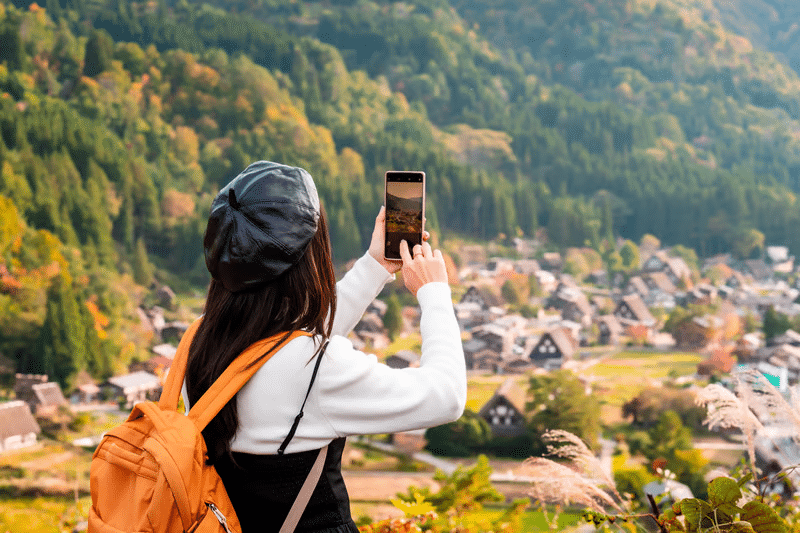
Japan’s countryside — the rice terraces, the mountain onsen, the farmhouse kitchens, the cedar forest shrines, the fishing harbors at dawn — is one of travel’s genuinely transformative experiences. Connectivity that works across this landscape, rather than failing at the moments when navigation or emergency communication matters most, is the practical foundation that makes rural Japan exploration confidently achievable.
The rural japan esim conclusion is the simplest in this guide series: Docomo, from Japan Sim Data, sized for the duration and WiFi availability of your rural itinerary. No other carrier provides equivalent coverage breadth across Japan’s countryside, and the difference between Docomo and the alternatives in genuinely remote areas is the difference between having a signal and not having one.
Download your offline maps before leaving the city. Carry a portable battery. Stop at convenience stores for large uploads. And trust that Docomo’s rural coverage provides the best possible foundation for exploring the Japan that most travelers never see.
Japan Sim Data’s Docomo-network eSIM plans for rural and countryside Japan are available at wordpress-1493298-6069223.cloudwaysapps.com.
Frequently Asked Questions
Q1: Does mobile data work at Japanese farmstays?
A: It depends entirely on the specific farmstay’s location. Farmstays in populated rural valleys typically have Docomo signal, while those in deep mountain or gorge locations may have no signal from any carrier. Research coverage at specific addresses using Docomo’s coverage map before booking, and treat any available farmstay WiFi as supplementary rather than primary connectivity.
Q2: Which Japanese carrier has the best rural coverage?
A: Docomo provides the most comprehensive rural coverage in Japan by a meaningful margin. It maintains signal further from population centers, covers more secondary and tertiary roads, and reaches remote villages and farmhouse areas where SoftBank and KDDI have no signal. For any rural Japan travel, Docomo is the unambiguous network recommendation.
Q3: How much data do I need for a week of rural Japan travel without reliable WiFi?
A: A week of rural Japan travel without reliable WiFi typically requires 15–20GB, covering continuous navigation, translation, and communication without the evening hotel WiFi top-up that urban Japan travelers rely on. Docomo unlimited eliminates data management anxiety entirely and is appropriate for extended rural itineraries where WiFi access is unpredictable.
Q4: Are offline maps essential for rural Japan travel?
A: Yes, without qualification. Rural Japan road signage is often Japanese-only, coverage drops occur on secondary mountain and forest roads, and the moment connectivity fails is typically the moment navigation is most needed. Download offline Google Maps tiles for every prefecture and region your rural itinerary covers before departing the last reliable WiFi connection.
Q5: Do convenience stores in rural Japan provide WiFi for travelers?
A: Yes. 7-Eleven, Lawson, and FamilyMart stores in rural Japan provide free WiFi, even in small towns where other connectivity options are limited. The convenience store WiFi stop is one of the most practical connectivity management strategies for rural Japan road trippers — use it for large uploads, app updates, and route planning that you don’t want to consume eSIM data for.