
Cherry Blossom Season eSIM: Best Plans for Sakura Travelers in Japan
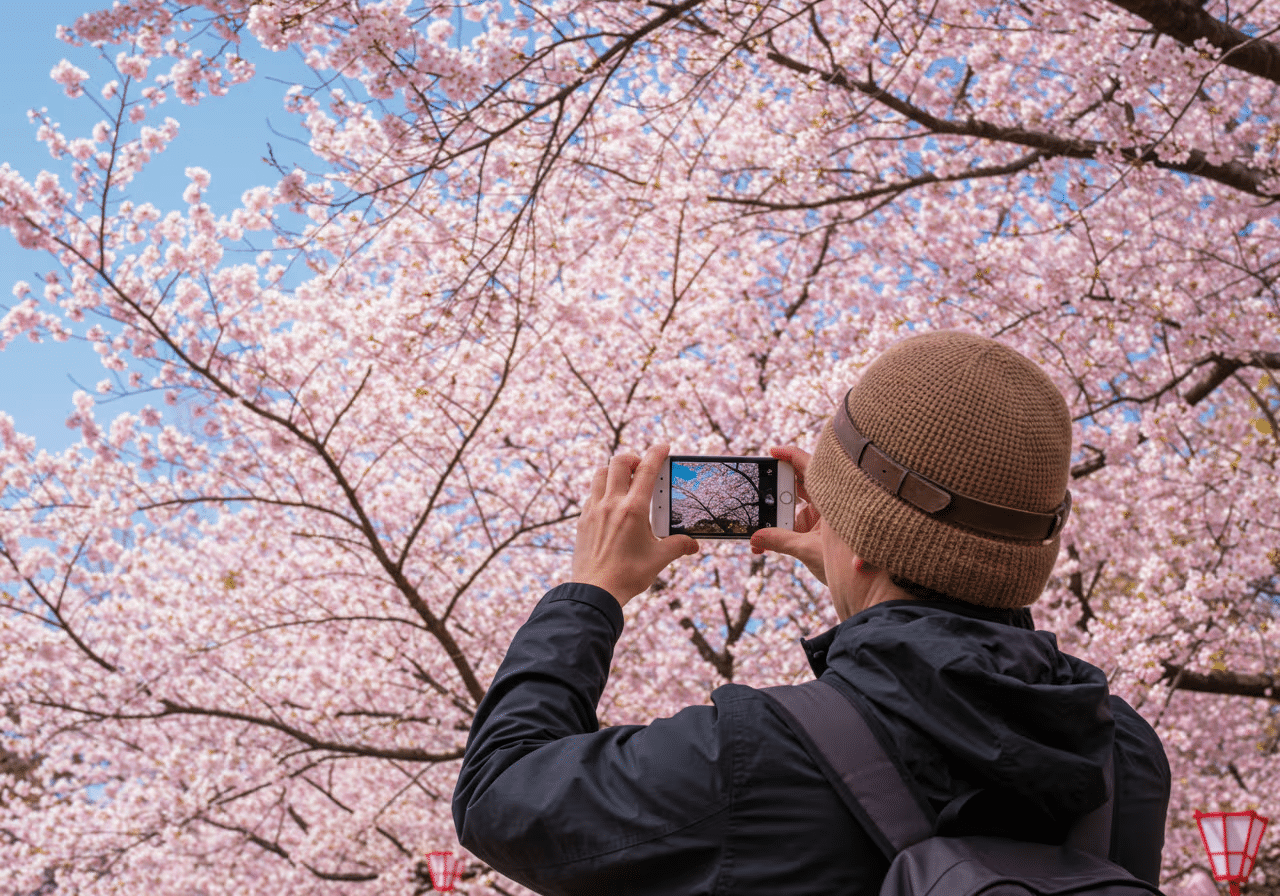
There is no travel season in Japan quite like sakura. The two-to-three week window when Japan’s cherry blossoms reach full bloom — moving northward from late March through April as temperature gradients guide the progression from Kyushu to Hokkaido — compresses an extraordinary volume of traveler desire, logistical complexity, and photographic opportunity into the most anticipated and most quickly sold-out travel period in the Japanese tourism calendar.
The cherry blossom eSIM Japan question requires understanding two dimensions simultaneously: the general connectivity landscape of sakura season travel, and the specific connectivity challenges that the season’s unique characteristics create. Sakura season doesn’t just bring travelers to Japan — it concentrates unprecedented numbers of visitors simultaneously at specific sites during specific weather windows. Maruyama Park in Kyoto at 10pm under illuminated trees during peak bloom. Chidorigafuchi in Tokyo on a Saturday afternoon with the moat bordered by overhanging blossoms. These moments are connectivity test environments unlike anything outside of major sporting events.
This guide covers the full sakura eSIM landscape: timing and data usage patterns, the connectivity reality at Japan’s most celebrated hanami sites, the apps that make sakura planning possible, photo documentation data considerations, and the Japan Sim Data plan configurations best suited to the traveler whose Japan trip is built around the world’s most beautiful flowering season.
Sakura Season Traveler Surge: The Connectivity Context
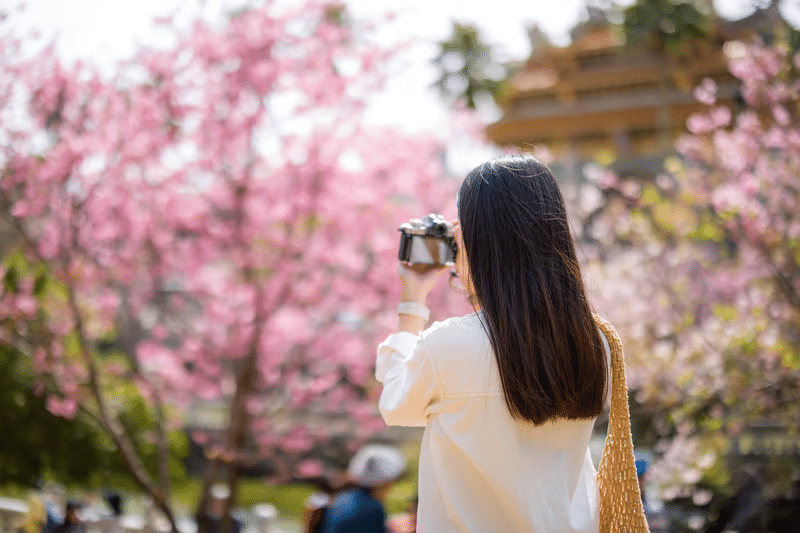
Japan’s cherry blossom season generates tourism demand that is unique in its concentration and intensity. Unlike general tourist season which distributes visitors across the year, sakura season creates a two-to-three week window when visitor numbers are at their annual peak, international flight prices reach their highest points, and accommodation in Japan’s major cities sells out months in advance.
For connectivity infrastructure, this concentration has implications that individual spot coverage maps don’t capture. The mobile networks serving Japan’s famous hanami sites are not sized for the visitor volumes that peak bloom days generate. Japan’s carriers have made significant investments in temporary capacity enhancements at major sites during sakura season, but the fundamental truth remains: during peak bloom at the most popular sites, network congestion is a real and predictable experience.
Understanding this going in — rather than arriving at Shinjuku Gyoen on a peak bloom Saturday with unlimited social sharing expectations — is the connectivity preparation that matters most for sakura season travel.
Best Times to Visit and Expected Data Usage
The Sakura Forecast Variable
japan esim march and japan esim april planning requires understanding that sakura season timing varies year to year based on winter temperature patterns. A warm February can advance peak bloom by a week or more; a cool spring can delay it. Major Japanese meteorological services and dedicated sakura forecast apps (discussed below) publish bloom forecasts from January onward.
For connectivity planning purposes, the key timing consideration is that peak bloom is brief — typically five to seven days when blossoms are at full flower before petals begin to fall. This brevity intensifies visitor concentration at hanami spots during exactly this window, creating the congestion conditions that affect connectivity most severely.
Data Usage During Sakura Season
Sakura travelers consistently use more data than equivalent Japan tourists visiting in other seasons. The photographic intensity of the sakura experience — the changing light conditions from morning through illuminated evening, the photographic opportunities that present themselves continuously across days of temple and park visits — drives data consumption that exceeds standard Japan tourism patterns.
Typical sakura season data usage for an active photographer and social sharer: 3–5GB per day during peak bloom days when documentation is most intensive, with moderate days in transit between bloom locations consuming 1–2GB. A ten-day sakura-focused Japan trip should budget 20–30GB, making unlimited plans the natural choice for travelers whose primary trip motivation is the visual experience of Japan’s most beautiful season.
Popular Sakura Spots and Their Connectivity
Tokyo Hanami Sites
Shinjuku Gyoen (新宿御苑)
Tokyo’s most popular hanami garden — with 1,100 cherry trees of multiple varieties providing the longest bloom window of any major Tokyo site — experiences extraordinary visitor volumes during peak bloom weeks. hanami connectivity at Shinjuku Gyoen is provided across all three carriers in the park’s open outdoor environment, but peak day congestion during mid-morning to mid-afternoon peak hours can significantly slow upload speeds.
Practical approach: capture your photography throughout the day, but plan major uploads for early morning (before crowds gather) or evening (after crowds thin) rather than competing for bandwidth during the midday rush.
Chidorigafuchi (千鳥ヶ淵)
The moat-side path bordering the Imperial Palace’s northwestern edge, with cherry trees overhanging the water, is one of Tokyo’s most photographed sakura locations. Open outdoor setting with good signal propagation across all carriers; congestion during peak hours reduces upload throughput but maintains navigation and messaging functionality.
Ueno Park (上野公園)
Tokyo’s largest and most famous hanami park — with hundreds of cherry trees along the central promenade — has strong coverage throughout the park’s outdoor areas on all carriers. As with other major sites, peak bloom days see congestion effects on upload speed during crowded periods.
Meguro River (目黒川)
The canal-side cherry tree-lined walk through Nakameguro — Tokyo’s most photographed neighborhood sakura experience, particularly under illumination in the evenings — has coverage throughout from all carriers. Evening illumination periods generate concentrated social sharing demand; Docomo’s capacity provides marginally more reliable upload performance.
Kyoto Hanami Sites
Maruyama Park (円山公園)
Kyoto’s most famous hanami park, centered on the weeping cherry tree that becomes the focal point of night illuminations, has coverage throughout its outdoor areas on all carriers. Peak bloom evenings — when the illuminated tree is at its most extraordinary and visitor concentration is at its highest — generate network demand that can slow uploads on any carrier.
Philosopher’s Path (哲学の道)
The canal-side path beneath cherry trees connecting Nanzen-ji to Ginkaku-ji is within Kyoto’s urban coverage zone for all carriers throughout its length. Coverage is consistent; congestion during peak midday hours follows the same pattern as other popular sites.
Kiyomizudera approach streets
The Sannen-zaka and Ninen-zaka preserved streets below Kiyomizudera temple, with cherry trees in the surrounding hillside, are well-covered across all carriers. The temple’s elevated position provides good signal propagation.
Less-Crowded Sakura Spots and Their Coverage Advantage
One of the practical connectivity advantages of visiting less-crowded sakura destinations is that the network congestion problem diminishes dramatically. The traveler who visits Hirosaki Castle in Aomori during Tohoku’s late-season bloom (late April to early May), Kakunodate in Akita with its samurai district cherry trees, or Yoshino in Nara with its 30,000-tree mountain hillside experiences both extraordinary sakura and significantly better network performance than at Japan’s most visited urban sites.
For Hirosaki and Kakunodate: Docomo provides the most reliable coverage in these regional destinations. For Yoshino: Docomo is the network recommendation for the mountain approach and upper sections beyond the main town.
Using Forecast Apps and Hanami Planning Tools
Sakura Forecast App Data Requirements
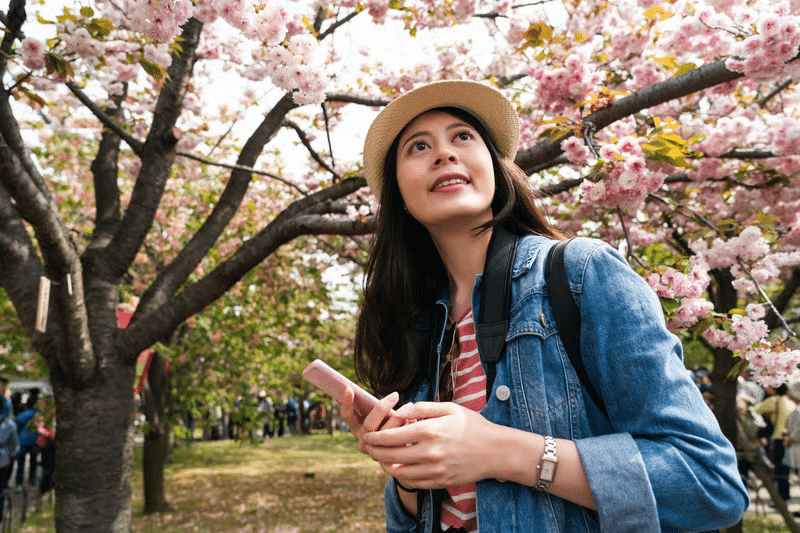
sakura forecast app usage is one of the most practically important data use cases for cherry blossom season travel. Japan’s cherry blossom forecast services update daily during the bloom season, and their data for trip planning — which regions are at full bloom, which are still in bud, which have already peaked — directly affects how travelers allocate limited Japan travel time.
Weather News Live (WeatherNews) — Japan’s most followed sakura forecast service, providing daily bloom updates by prefecture and major location. The app requires data for real-time forecast access.
Japan Meteorological Corporation (日本気象協会) — Official-level bloom forecasting with regional precision. Web-based access requires data connection.
Google Maps sakura layers — Google’s Japan cherry blossom overlays provide crowd-sourced bloom condition reporting at specific locations during the season. Requires data connection.
NHK Weather — NHK’s weather service incorporates sakura forecast updates during the season in accessible Japanese that can be supplemented by translation apps.
The data consumption for forecast app use is modest — these are primarily text and light map services — but daily consultation throughout a sakura trip adds to the general data budget.
Hanami Planning Tool Connectivity
Planning tools for hanami visits — checking entrance fees for specific parks, confirming illumination schedules at key sites, researching picnic spot logistics at specific parks — all require data access for real-time information that changes daily during peak season.
Photo Backup and Social Sharing Data Considerations
The Sakura Photography Data Challenge
The cherry blossom photo upload japan data consumption is the dominant data use driver for sakura season travelers, and it differs from standard Japan tourism photography in both volume and timing.
Volume: Sakura travelers photograph more intensively than equivalent non-sakura tourists. The changing light conditions across a single day at a single site — morning mist, midday clarity, golden hour warmth, twilight illumination — create photographic opportunities that experienced photographers pursue continuously. A single hanami day can generate hundreds of photos and multiple video clips.
Timing concentration: The best photography at hanami sites happens at predictable times — dawn at uncrowded sites before crowds arrive, the golden hour before sunset, and the first hour of evening illumination. These moments also concentrate the social sharing impulse — the urge to share the extraordinary image in the moment it’s captured is strongest at exactly the moments when network congestion is highest.
The Upload Timing Strategy
The practical solution for cherry blossom data plan management is separating capture from upload. Photograph continuously throughout the day, saving all content locally on the device. Reserve major uploads for:
- Early morning before visiting hanami sites (hotel WiFi or quiet morning period)
- During transit (Shinkansen journeys maintain signal and often have less demand than stationary site visits)
- Evening return to accommodation (hotel WiFi for highest-quality full-resolution uploads)
This separation of capture from upload reduces in-site data consumption, avoids the congestion periods at peak sites, and generally results in better upload success rates than attempting real-time sharing from congested hanami sites.
Cloud Backup Considerations
For photographers whose smartphone storage fills during an intensive sakura documentation day, cloud backup (Google Photos, iCloud, Amazon Photos) consumes significant data when performed over eSIM rather than WiFi. Configure auto-backup to WiFi-only in phone settings before the trip and perform manual backup at hotel WiFi to avoid unintentional large data consumption from automatic cloud uploads during active photography periods.
Best Japan Sim Data Plans for Sakura Season
Network Recommendation
For sakura season travel covering multiple regions as the bloom progresses northward — beginning in Kyushu and western Japan, moving through Kansai and the Chubu region, then to the Kanto area and eventually Tohoku and Hokkaido — Docomo’s national coverage breadth is the network recommendation. Travelers whose sakura itinerary remains within the major urban centers (Tokyo, Kyoto, Osaka) can use any carrier.
Plan Sizing
Unlimited: The clear recommendation for the most photography-intensive sakura season travelers. Unlimited plans eliminate data management anxiety during the most photogenic two weeks of Japan’s annual tourism calendar. For travelers whose primary trip motivation is the visual experience of cherry blossom season, data should be the one variable that doesn’t require management.
20GB Fixed: An adequate specification for travelers with moderate social sharing habits who will supplement eSIM data with hotel WiFi for major uploads. A 20GB plan covers ten days of sakura travel with careful daily management.
15GB Fixed: The minimum recommended sizing for a ten-day sakura season trip. Travelers on 15GB plans should implement the upload timing strategy described above to avoid approaching plan limits during peak photography days.
seasonal notes on plan selection
docomo spring travel plans from Japan Sim Data cover the full sakura season geography without network gaps as the bloom moves northward. softbank sakura season and kddi cherry blossom plans are appropriate for urban-concentrated itineraries in Tokyo, Osaka, and Kyoto where bloom viewing stays within the major cities’ comprehensive coverage zones.
The spring japan esim unlimited from Japan Sim Data on the Docomo network is the sakura season recommendation for travelers building their Japan trip around the flowering season specifically.
According to the Japan National Tourism Organization (JNTO), cherry blossom season generates Japan’s highest single-season inbound visitor concentration, with advance booking patterns showing the season selling out many months ahead of the March-April peak. The GSMA identifies seasonal event tourism as one of the highest-growth eSIM use cases, with Japan’s sakura season cited as a leading example of a high-demand connectivity period.
Conclusion: Sakura Season Deserves Unlimited Connectivity
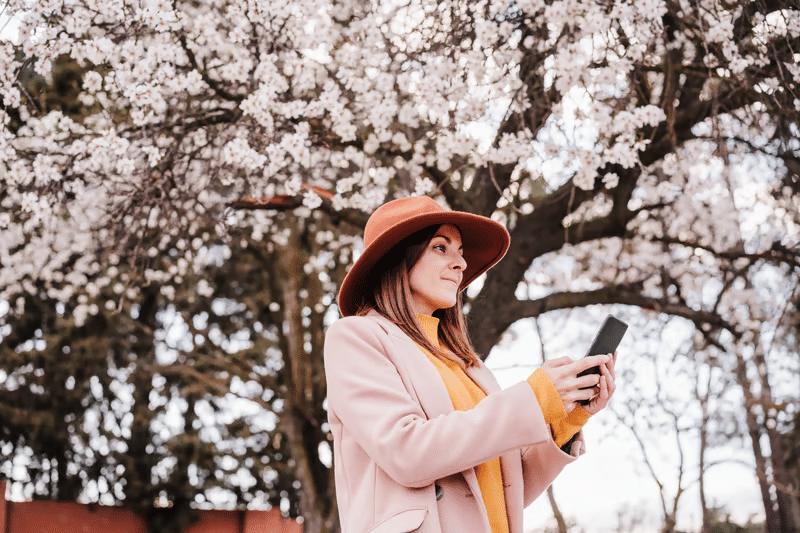
Japan’s cherry blossom season is the most photographed, most anticipated, and most emotionally resonant two weeks in Japanese tourism. The connectivity that supports this experience — navigating between bloom locations, checking daily forecast updates, coordinating with travel companions, and sharing the extraordinary images that sakura season generates — is foundational rather than peripheral to the traveler’s relationship with the experience.
The cherry blossom esim japan recommendation is clear: Docomo unlimited from Japan Sim Data for travelers whose sakura itinerary extends across Japan’s geographic range, and a minimum 15–20GB plan for those concentrating in major urban hanami sites. Download your sakura forecast apps before departure. Configure cloud backup to WiFi-only. Time your uploads for morning, transit, and accommodation rather than peak site congestion periods.
And most importantly: when you’re standing under the Maruyama weeping cherry in full bloom at midnight under illumination, let your phone’s battery do the photography and your eyes do the remembering.
Japan Sim Data’s eSIM plans for sakura season Japan are available at wordpress-1493298-6069223.cloudwaysapps.com.
Frequently Asked Questions
Q1: Is network congestion at popular sakura spots a serious problem?
A: Congestion during peak bloom at major hanami sites affects upload speeds — particularly during the busiest midday hours — but doesn’t prevent messaging, navigation, or photography capture. The practical management is timing major uploads for early morning, transit periods, or evening at accommodation rather than attempting real-time high-quality uploads during peak site congestion.
Q2: What data plan size is right for a ten-day sakura season trip?
A: Unlimited is the recommended sizing for photography-intensive sakura travelers. If fixed data is preferred, 20GB covers a ten-day sakura trip with careful upload timing management; 15GB is the minimum for moderate social sharers supplementing with hotel WiFi. Sakura season travelers consistently underestimate their data usage — size generously.
Q3: Do sakura forecast apps require mobile data?
A: Yes. Japan’s main sakura forecast services — WeatherNews, Japan Meteorological Corporation, and Google’s sakura layers — require data connections for real-time bloom updates. Data consumption for forecast apps is modest (primarily text and light maps), but daily forecast checking adds to the overall sakura season data budget.
Q4: Which carrier handles sakura season congestion best?
A: All carriers experience congestion at peak hanami sites during peak bloom. Docomo’s network capacity provides marginally more resilient performance during peak demand periods. For sakura itineraries extending to Tohoku and Hokkaido for late-season bloom, Docomo’s rural coverage advantage becomes additionally significant.
Q5: Should I configure cloud backup differently during sakura season travel?
A: Yes. Set automatic cloud backup (Google Photos, iCloud) to WiFi-only before departure. Automatic cloud backup over eSIM data during intensive photography days can consume several gigabytes unexpectedly. Perform manual backup at hotel WiFi each evening for the best combination of data efficiency and photo security.