
Best Japan eSIM for Cruise Passengers: Port Days and Shore Excursions

Cruise travel to Japan presents a connectivity challenge that is structurally different from any land-based Japan tourism scenario. Where the hotel-based traveler has accommodation WiFi as a nightly data anchor, and the transit traveler has continuous eSIM connectivity across the full journey, the cruise passenger’s Japan experience is divided into discrete port days — eight to twelve hours of shore time at a specific Japanese city, followed by a return to the ship where Japanese carrier coverage fades as the vessel moves to sea.
This port-day structure creates the connectivity planning problem that the japan cruise esim question addresses: how do you obtain local Japanese network connectivity for a specific, defined period at each port, without paying for a multi-week plan that covers days when you’re at sea with no need for Japan data?
The answer is the Day Pass eSIM model — and understanding why it fits cruise travel better than any other connectivity product, alongside the specific connectivity profiles of Japan’s major cruise ports, is what this guide covers.
Cruise Connectivity Gaps: The Ship-to-Shore Transition
What Cruise Ship Connectivity Provides
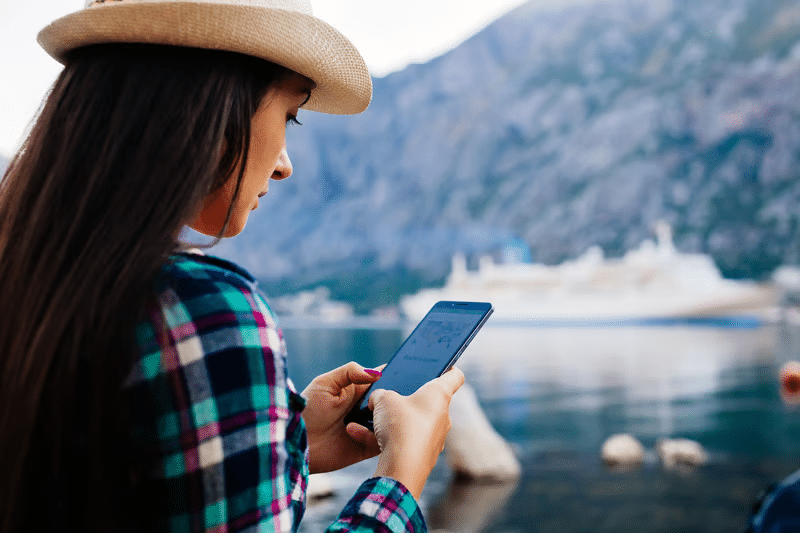
Modern cruise ships typically offer satellite-based WiFi services — purchased as packages by passengers for use throughout the voyage. This connectivity is useful for social media, email, and messaging while at sea, but has limitations that become apparent during Japan port days:
Cost: Cruise ship WiFi is expensive relative to data volume delivered. High-speed packages on major cruise lines typically cost USD $15–30 per day.
Speed limitations: Satellite connectivity latency (the signal traveling from ship to satellite to ground station) creates response delays that make certain applications — video calls, real-time navigation — noticeably less responsive than terrestrial mobile connections.
Coverage in port: Cruise ship WiFi may or may not function while the ship is docked in a Japanese port. Some ships switch satellite connectivity on and off during port stays; others maintain it. This variability means the cruise passenger cannot reliably depend on ship WiFi during shore time.
Japanese network advantages: For shore activities requiring real-time navigation, translation, local information access, and communication with Japanese services — restaurants, local transport, attraction bookings — a direct Japanese carrier network connection through a Japan eSIM provides superior performance to satellite WiFi in every dimension that matters on land.
Common Japan Cruise Ports: Coverage Profiles
Yokohama (for Tokyo)
The most significant Japan cruise port for international itineraries, Yokohama serves as the gateway for Tokyo access — passengers typically spend port days either exploring Yokohama’s own attractions (Chinatown, Minato Mirai waterfront, Red Brick Warehouse) or taking the train to central Tokyo.
Coverage throughout Yokohama’s tourist and port areas is comprehensive across all three carriers. The train journey to Tokyo maintains coverage throughout on all carriers. docomo cruise port performance at Yokohama is excellent; softbank cruise japan and kddi cruise coverage are equally strong for this urban port environment.
For the Yokohama-to-Tokyo day excursion: any Japan Sim Data network provides reliable connectivity for the full day. Navigation from Yokohama station to Shinjuku or Asakusa, real-time translation at Tokyo restaurants, and communication throughout the day are all well-supported.
Kobe (for Osaka and Kyoto)
Kobe’s position as the Kansai gateway makes it a high-value port for passengers wanting to reach Osaka’s food culture or Kyoto’s temple heritage on a single port day. The logistics of this excursion — Kobe to Osaka by train (30 minutes), or Kobe to Kyoto (70 minutes) — require real-time navigation that a local Japanese eSIM handles better than cruise ship WiFi or home carrier roaming.
Coverage in Kobe’s port area and throughout the city is strong on all carriers. The Osaka and Kyoto destinations reached by day excursion from Kobe are within Japan’s most comprehensively covered urban network corridor. Any Japan Sim Data carrier works excellently for Kobe port day excursions.
Nagasaki
Nagasaki cruise port calls are increasingly common on Pacific itineraries, with the city’s extraordinary Peace Memorial (Nagasaki Atomic Bomb Museum) and historical architecture creating a compelling port day destination.
Coverage in central Nagasaki is adequate across all carriers for the main tourist circuit. The Glover Garden, Nagasaki Chinatown, and the Peace Park are all within coverage zones that support navigation, translation, and communication throughout a port day. Docomo provides the most reliable coverage for excursions extending into Nagasaki’s hillside neighborhoods and approaches to more remote viewpoints.
Okinawa (Naha)
Naha is an increasingly popular Japan cruise port — Okinawa’s distinctive culture, subtropical climate, and proximity to the main tourist areas make it an accessible and rewarding port day destination. Coverage in Naha and the central Okinawa tourist corridor is supported by all carriers. For excursions extending to northern main island areas or nearby islands accessible by ferry, Docomo’s coverage advantage becomes relevant.
Hokkaido (Hakodate, Otaru)
Hakodate and Otaru are the primary Hokkaido cruise ports. Hakodate’s coverage supports navigation throughout the city’s main attractions — the Goryokaku star fort, the Motomachi foreign settlement, the morning market — adequately on Docomo and reasonably on other carriers. Otaru’s compact historic canal district has adequate coverage on all carriers for the typical port day tourist circuit.
For Hokkaido cruise ports, Docomo’s coverage advantage is most relevant for excursions extending beyond the port city toward rural Hokkaido destinations — the occasional shore excursion toward the volcanic Onuma area from Hakodate, for example.
eSIM Tips for Short Port Days
The Port Day Timing Challenge
The cruise passenger’s port day is time-constrained in a way that no other Japan travel scenario is. An eight-hour port window with a hard return time to the ship creates a travel pace where navigation errors, connectivity failures, and information gaps have direct consequences for the timeline.
The esim for japan cruise port day strategy must account for this time pressure:
Pre-activate before going ashore: Your Japan eSIM should be installed before the voyage and set to activate when the ship docks in a Japanese port. Do not wait until you’re walking down the gangway to try to install or activate — the time pressure of the port day makes arrival-day installation impractical.
Download offline maps before docking: As the ship approaches port, use the satellite WiFi to download offline Google Maps tiles for the port city and any excursion destinations. This ensures navigation capability even if mobile data is temporarily slow or unavailable.
Have key information saved offline: Restaurant options, attraction addresses in Japanese characters, and the return transport schedule back to the port should be saved or screenshotted before leaving the ship, ensuring access without real-time data dependency.
Activation Timing at Port
Japan’s carrier signals typically extend offshore to several nautical miles from the coast. As a cruise ship approaches a Japanese port, passengers with Japan eSIMs installed and ready may find connectivity activating while the ship is still in the harbor approach — providing connectivity before docking and the gangway opens.
This early activation advantage means that by the time the shore excursion begins, the Japan eSIM is already confirmed active, notifications are coming through, and navigation is ready rather than requiring setup time on the pier.
Data Usage for Shore Excursions and Translation
Navigation Data for Port Day Excursions
The japan esim excursion data usage pattern for a typical eight-hour port day:
Navigation: 300–500MB for continuous Google Maps use across a full port day — route planning, walking navigation, transit routing.
Translation: 100–300MB for camera-function translation at restaurants, shrine information boards, and attraction descriptions.
Social sharing: Variable — 500MB–2GB depending on photography intensity and social media activity.
Communication: 50–100MB for messaging with ship contacts, travel companions, and any shore excursion coordination.
Total typical port day consumption: 1–3GB for a standard shore excursion with moderate social sharing.
This consumption profile is well within a single Day Pass allocation. The Day Pass structure — providing a daily data allowance adequate for full-day use — matches port day connectivity needs directly.
Translation at Cultural Sites
Japan cruise passengers often visit sites where real-time translation significantly enhances the experience — Nagasaki’s Peace Memorial Museum, Hakodate’s Goryokaku Park history, Okinawa’s Shuri Castle context. Google Translate’s camera function transforms a Japanese-only information board into accessible English in real time, requiring a live data connection.
The japan tourist connectivity cruise argument for a dedicated Japan eSIM rather than cruise ship WiFi is most compelling at cultural sites where translation quality directly affects the depth of the experience.
Choosing Between Day Pass and Short Data Plans

Why Day Pass Fits Cruise Travel
The japan esim day port model using Day Pass is the most cost-efficient structure for cruise passengers for a straightforward reason: you need Japan connectivity only on the specific days your ship is docked at a Japanese port.
A cruise itinerary with three Japan port stops — Yokohama, Kobe, and Nagasaki — requires three Day Pass activations. Not a ten-day plan covering the sea days between ports. Not a multi-destination plan that includes Japan within a broader Asia Pacific coverage structure. Three specific Day Pass activations on three specific Japan days.
The japan esim quick visit Day Pass structure means you pay only for the days you’re actually in Japan. For a cruise with two Japan ports separated by two sea days, this is four times more efficient than a continuous plan covering all six days.
When a Short Fixed Plan Makes More Sense
Some cruise itineraries have multiple Japan ports in quick succession — three ports in five days, for example, with only one sea day between them. In this case, a 5-day or 7-day fixed data plan may be more economical than individual Day Pass activations for each port, particularly if the fixed plan’s per-GB cost is lower than the Day Pass equivalent.
The calculation: multiply the number of Japan port days by the Day Pass cost and compare to the cheapest fixed plan covering the same period. If the fixed plan is cheaper and the total data volume is sufficient, the fixed plan wins. If Japan port days are few and widely spaced, Day Pass wins.
Best Japan Sim Data Plans for Cruise Travelers
Product Recommendation: Day Pass First
cruise japan data plan recommendation from Japan Sim Data: Day Pass eSIM for the majority of cruise passengers, because the Day Pass structure matches the cruise travel pattern more efficiently than any continuous plan.
Purchase a Japan Day Pass eSIM before departure. Install the eSIM profile before boarding your cruise. On each Japan port day, activate the Day Pass when the ship approaches the port. Use for the full shore excursion. The activation expires at midnight; sea day sailing the following day consumes no plan value.
Network Recommendation for Cruise Ports
For Japan cruise ports at major metropolitan gateways (Yokohama, Kobe): any carrier provides excellent coverage. The urban network in these gateway ports is comprehensive across all three carriers.
For Japan cruise ports at regional destinations (Hakodate, Nagasaki, Okinawa Naha): Docomo provides the most consistent coverage across the port city and any excursion distances beyond the immediate port area. For shore excursions extending to rural or coastal areas beyond the main port city, Docomo’s national coverage advantage is operationally significant.
For cruises with mixed port profiles — major gateway ports alongside regional destinations — specifying Docomo ensures consistent coverage across all Japan ports without network switching.
For the Multi-Voyage Japan Cruise Traveler
The cruise passenger who visits Japan multiple times per year on different voyages benefits from Japan Sim Data’s eSIM account structure — a Docomo eSIM profile installed once can be reactivated or renewed for each Japan voyage, eliminating the need to purchase and install a new eSIM for each cruise season.
According to the Japan National Tourism Organization (JNTO), Japan’s cruise tourism sector has grown significantly, with Yokohama, Kobe, and Okinawa among Japan’s most visited cruise ports. The GSMA, notes that Day Pass eSIM products are the fastest-growing segment of travel eSIM globally, with cruise port day connectivity identified as the primary use case driving Day Pass adoption.
Conclusion: Day Pass eSIM Is the Cruise Passenger’s Connectivity Solution
The japan cruise connectivity planning conclusion is one of this guide series’ clearest: cruise passengers need Day Pass eSIM, not continuous multi-week plans. The port-day structure of cruise Japan travel maps precisely onto the Day Pass product structure — you pay for Japan connectivity on Japan days and nothing on sea days.
Install your Japan Sim Data Day Pass eSIM before boarding. Activate on approach to each Japanese port. Use for the full shore excursion — navigation, translation, social sharing, communication. Return to the ship with the day’s photography captured and uploaded, and the Japan experience deepened by connectivity that made every cultural encounter more accessible.
Japan Sim Data’s Day Pass eSIM plans on Docomo, SoftBank, and KDDI networks for cruise passengers are available at wordpress-1493298-6069223.cloudwaysapps.com — purchase before your voyage, install before you board, and arrive at your first Japan port already connected.
Frequently Asked Questions

Q1: Should cruise passengers use Day Pass or a multi-day eSIM plan for Japan ports?
A: Day Pass is the recommended structure for most cruise passengers. It provides Japan connectivity only on the specific days your ship is docked at a Japanese port — you pay for port days only, not sea days between them. For cruises with many Japan ports in quick succession, compare Day Pass total cost against a short fixed plan.
Q2: Which Japanese carrier is best for cruise port day connectivity?
A: For major gateway ports (Yokohama, Kobe), any carrier provides excellent coverage. For regional cruise ports (Hakodate, Nagasaki, Okinawa Naha) and any shore excursions extending beyond the main port city, Docomo’s national coverage breadth provides the most reliable connectivity. A Docomo Day Pass covers all Japan cruise ports reliably.
Q3: Can I use cruise ship WiFi instead of a Japan eSIM?
A: Cruise ship WiFi functions via satellite and may not operate reliably during port stays. More importantly, ship WiFi’s satellite latency makes navigation apps and real-time translation noticeably less responsive than a local Japanese carrier eSIM connection. For shore excursion use cases, a Japan eSIM provides meaningfully better performance than satellite WiFi.
Q4: How much data does a typical Japan port day shore excursion use?
A: A typical eight-hour Japan port day with continuous navigation, camera translation, moderate photography sharing, and messaging consumes approximately 1–3GB. A standard Day Pass allocation covers this comfortably. Photography-intensive passengers sharing high volumes of social media content may approach the upper end of this range.
Q5: When should I activate my Japan eSIM Day Pass during a cruise?
A: Activate as the ship approaches the Japanese port — carrier signals extend offshore, and the Day Pass may activate automatically when your device detects the Japanese network. Confirm activation before going ashore. The Day Pass validity typically runs from activation through midnight of the same calendar day, covering the full shore excursion window for morning port calls.