

Autumn Foliage eSIM Guide: Best Plans for Koyo Season in Japan
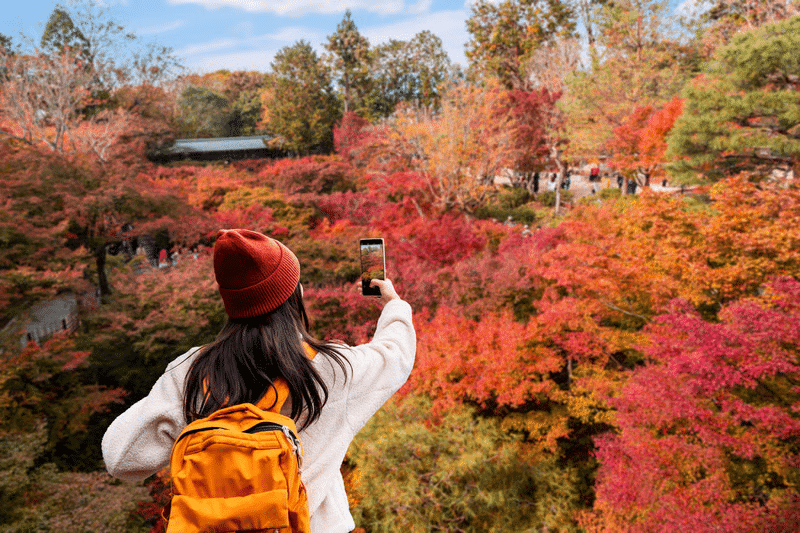
Japan’s autumn foliage season — koyo (紅葉), the turning of maple, ginkgo, and beech leaves into the extraordinary red, orange, and gold palette that transforms Japan’s temple gardens, mountain valleys, and city parks each October and November — is the second great seasonal travel surge in the Japanese tourism calendar. Where sakura concentrates in a narrow March-April window, koyo is more forgiving in its timing and more geographically distributed, with the color front moving southward from Hokkaido’s late September transformation through Tohoku, the Japan Alps, and Kansai’s temple gardens, reaching Kyushu by late November.
The autumn foliage eSIM Japan question shares some characteristics with the sakura season connectivity challenge but differs in important ways. Koyo season’s most celebrated viewing locations include mountain and rural destinations that sakura’s urban concentration doesn’t: Nikko’s ancient cedar-and-maple forest, Daisetsuzan’s remote alpine zone in Hokkaido, the Hida Valley approach to Takayama, the Sounkyo Gorge in the Daisetsuzan range. These mountain and rural settings introduce connectivity considerations that purely urban sakura hanami doesn’t.
This guide covers the full koyo eSIM landscape: regional timing across Japan’s geographic range, mountain and rural connectivity considerations specific to foliage viewing locations, carrier comparison for autumn travel, and Japan Sim Data plan recommendations for the season’s distinctive data needs.
Koyo Season Travel Appeal

Koyo season’s travel appeal is distinct from sakura in character as well as timing. Where hanami is communal — the picnic under the trees, the crowded park, the social celebration of spring’s return — koyo is more contemplative in spirit. The Eizan Railway’s illuminated maple tunnel in Kyoto, the reflection of red maples in Kenroku-en garden’s pond, the Sounkyo Gorge’s vertical walls of color viewed from a narrow valley floor — these experiences reward the slower pace and the quieter moment.
For the travel agency professional reading this as part of the series: koyo season tour clients are often different from sakura season clients — more likely to include repeat Japan visitors, more interested in rural and mountain destinations alongside urban temple gardens, and correspondingly more likely to have itineraries that venture into the connectivity-variable terrain that Docomo’s rural network advantage addresses.
Regional Timing: From Hokkaido to Kyushu
Hokkaido (Late September to Mid-October)
Daisetsuzan National Park — Japan’s largest national park and its alpine heart — experiences Japan’s earliest koyo, with the alpine zone above 1,500 meters turning color in mid-to-late September. This extraordinary alpine foliage, combined with Hokkaido’s general koyo peak in early-to-mid October, makes Hokkaido the starting destination for travelers planning to chase the color front southward.
Japan esim october planning for Hokkaido koyo requires the same Docomo-first network recommendation that applies to Hokkaido travel generally — Daisetsuzan’s mountain approach roads, the Sounkyo Gorge, and the rural landscapes of central Hokkaido all benefit from Docomo’s superior rural coverage.
Tohoku (Mid to Late October)
Tohoku’s koyo peaks in mid-October at higher elevations — the Hakkoda Mountains near Aomori, the Towada Lake basin, the Nyūtō Onsen mountain area in Akita — and in late October in the valley floor areas. Tohoku’s foliage is among Japan’s most dramatic, occurring in a landscape of cedar forests, volcanic lakes, and river gorges where coverage follows the familiar rural Japan pattern: adequate in town areas, variable on mountain approach roads, and limited in specific gorge and forest environments.
Japan Alps and Chubu (Late October)
The Japan Alps koyo peak — particularly spectacular in the Tateyama-Kurobe Alpine Route (until its late October closure), the Kamikochi valley floor, and the mountain approaches to Nikko — coincides with the highest visitor volumes of the alpine year. Coverage at these mountain destinations follows the profiles discussed in the Japan Alps eSIM guide: Docomo in the accessible mountain visitor areas, limited coverage in the high alpine terrain.
Nikko (Late October to Mid-November)
Nikko — the World Heritage mausoleum complex set in a cedar and maple forest in Tochigi Prefecture, accessible from Tokyo in under two hours — is one of Japan’s most celebrated koyo destinations. The combination of extraordinary Edo-period architecture (Tosho-gu shrine, Rinno-ji temple) and autumn color that frames and transforms these buildings makes Nikko one of koyo season’s most photogenic environments.
Coverage in the main Nikko temple and shrine precinct area is adequate on Docomo and reasonable on other carriers. The approach roads further into the Nikko mountains — toward Chuzenji Lake and Kegon Falls, and further into the Oku-Nikko highland area — become progressively more Docomo-dependent as they move away from the main tourist infrastructure.
Kyoto and Kansai (Mid to Late November)
Kyoto’s koyo peak — typically mid-to-late November — transforms the city’s temple gardens into the most visited autumn foliage destination in Japan. The maple gardens of Tofuku-ji, the Arashiyama valley’s hillside color, the Eikan-do temple’s maple-covered hillside at evening illumination, and Rurikoin’s reflected maple canopy are among Japan’s most celebrated koyo experiences.
Coverage across Kyoto’s temple foliage circuit is excellent on all three carriers — the urban environment’s comprehensive network infrastructure eliminates any coverage concern. The koyo connectivity challenge in Kyoto is the same as the sakura connectivity challenge: not absence of signal but congestion during peak viewing hours at the most popular sites.
Kyushu (Late November to Early December)
Kyushu’s koyo peaks last, with the red maples of the Yufuin and Kurokawa Onsen areas and the ginkgo trees of Nagasaki and Fukuoka extending the season into late November and early December.
Rural and Mountain Connectivity Considerations
The autumn foliage connectivity challenge is more geographically complex than the sakura connectivity challenge precisely because koyo’s most celebrated locations include mountain and rural destinations that urban-focused sakura viewing doesn’t encounter.
Specific Koyo Destinations and Coverage Reality
Sounkyo Gorge (Hokkaido, Daisetsuzan): The dramatic gorge carved by the Ishikari River through the Daisetsuzan range is one of Japan’s premier koyo destinations. Coverage in the Sounkyo onsen town at the gorge entrance is present on Docomo. The gorge walk and the ropeway ascent to Kurodake become progressively coverage-limited as elevation increases.
Towada Lake (Aomori/Akita border): The volcanic caldera lake with extraordinary autumn color reflecting in the water has Docomo coverage around the main visitor areas and Yasumiya resort zone. The Towada-Hachimantai National Park surrounding area has the variable coverage of Tohoku’s mountain interior.
Chuzenji Lake and Kegon Falls (Nikko): The lake and waterfall above Nikko’s main temple area are accessible via the Irohazaka switchback road — one of Japan’s most famous autumn drives. Coverage is adequate in the lake shore area on Docomo; the switchback road itself has variable signal as it climbs through the forest.
Hida Valley (Gifu/Nagano, approaching Shirakawa-go): The train journey through the Hida Valley on the limited express from Nagoya to Takayama offers extraordinary autumn views of river gorge and mountain forest. This is one of Japan’s most scenic train rides in koyo season — coverage along the valley floor railway is present but variable, with Docomo providing the most consistent connectivity through the tunnel and gorge sections.
Best Carriers for Koyo Regions

docomo autumn travel: The Consistent Recommendation
Docomo’s rural and mountain coverage advantage is more operationally significant for koyo season than for sakura season, precisely because koyo’s celebrated destinations extend into the mountain and rural environments where Docomo’s infrastructure investment pays off in coverage continuity.
For koyo itineraries covering Hokkaido, Tohoku, the Japan Alps, and Nikko — destinations where the foliage is most dramatic precisely because the natural environment is most wild and remote — Docomo is the network specification that ensures connectivity in the approach areas, viewpoints, and mountain onsen that frame the autumn color experience.
softbank autumn japan and kddi koyo
softbank autumn japan and kddi koyo are appropriate for koyo season travelers whose autumn itinerary concentrates in Japan’s major cities — Kyoto’s temple circuit, Tokyo’s Shinjuku Gyoen and Showa Memorial Park, and the urban foliage viewing that requires the same urban connectivity excellence that these carriers provide year-round. For travelers extending beyond urban koyo to mountain and rural destinations, Docomo’s coverage advantage becomes operationally significant.
Photo, Translation, and Navigation Data Needs for Koyo Season
Koyo Photography Data
koyo photography japan data consumption is significant but has different characteristics from sakura photography. Where sakura documentation is concentrated at specific peak sites during the bloom window, koyo photography is more distributed — the color appears in the landscape throughout multi-day mountain and rural itineraries, not just at specific viewing parks.
The mountain road drive through autumn color, the forest path to a remote temple, the river gorge reflected in lake water — these photography subjects occur continuously throughout a koyo itinerary rather than concentrated at specific hanami sites. The result is sustained moderate photography data consumption rather than the intense peak-site documentation that sakura generates.
Estimated koyo photography data consumption: 2–3GB per day for actively photographing and social sharing travelers; 1–2GB for moderate users. A ten-day koyo itinerary should budget 15–25GB depending on sharing intensity.
Navigation for Koyo Season
Navigation is more practically important for koyo season than sakura season because koyo’s best locations often require road navigation to reach — the switchback mountain road to Chuzenji Lake, the rural approach to a Tohoku onsen with autumn views, the forest service road to a specific viewpoint that doesn’t appear prominently in tourist literature.
Japan esim seasonal navigation for koyo travelers benefits from: offline map tiles for all regions in the itinerary (particularly mountain areas where real-time data may be intermittent), the Japanese road navigation app (Yahoo! Carnavitime or Google Maps Japan) for the switchback and mountain road approaches that require turn-by-turn guidance.
Translation for Rural Koyo Destinations
Translation needs during koyo season are higher than during sakura season because koyo’s rural and mountain destinations have significantly less English-language signage than Tokyo or Kyoto. Regional information boards at mountain viewpoints, local restaurant menus in mountain onsen towns, and accommodation check-in at rural ryokan all benefit from Google Translate’s camera function — requiring data connection for best results.
Recommended Japan Sim Data Plans for Koyo Season
Network Recommendation
autumn foliage connectivity across the full koyo season geographic range requires Docomo for any itinerary extending into mountain or rural foliage destinations. For city-only koyo viewing (Kyoto, Tokyo), any Japan Sim Data carrier provides equivalent connectivity.
Plan Sizing for Koyo Season
Unlimited: Recommended for travelers whose koyo itinerary covers multiple regions — particularly those combining Hokkaido early-season alpine foliage with Tohoku mountain koyo and Kyoto late-season temple gardens. The navigation intensity of mountain driving, combined with sustained photography documentation, makes unlimited the appropriate choice for the most comprehensive koyo itineraries.
20GB: The recommended fixed-data specification for typical ten-day koyo itineraries covering both urban and mountain foliage destinations. Adequate for the combination of mountain navigation, moderate photography sharing, and daily communication without requiring unlimited plan investment.
15GB: Appropriate for koyo travelers whose itinerary is primarily urban (Kyoto, Tokyo, Nikko’s accessible main precinct) with hotel WiFi available each evening for major uploads.
Autumn Data plan Considerations
The autumn japan data plan consideration specific to koyo season that doesn’t apply to sakura: multi-day stays in mountain onsen ryokan without reliable WiFi are common in koyo season itineraries, requiring the eSIM to carry a higher proportion of the total data load than urban-based itineraries where hotel WiFi supplements eSIM data each evening.
The fall japan esim unlimited specification eliminates this dependency concern entirely and is worth the modest premium for travelers planning multiple rural ryokan stays during the koyo season period.
According to the Japan National Tourism Organization (JNTO), Japan’s autumn foliage season generates the second-highest inbound visitor numbers of any seasonal period, with Kyoto and Hokkaido’s koyo experiences cited as primary travel motivators. The GSMA notes that seasonal foliage tourism represents a high-value eSIM use case globally, with Japan’s koyo season identified as generating above-average per-visitor data consumption due to photography intensity and rural navigation demands.
Conclusion: Chase the Color Front with Docomo Confidence

Japan’s autumn foliage season — from Daisetsuzan’s September alpine gold to Kyushu’s November street ginkgo — is one of travel’s great seasonal privileges. The connectivity that supports chasing that color front across Japan’s geographic range, from Hokkaido’s mountain wilderness to Kyoto’s illuminated temple gardens, is best provided by Japan’s most comprehensive rural network.
The autumn foliage esim japan recommendation is Docomo for mountain and rural koyo destinations, unlimited or 20GB for itineraries spanning the full seasonal range, and the offline map download practice that ensures navigation continuity in the mountain road environments where koyo is most dramatic.
Japan Sim Data’s Docomo-network eSIM plans for koyo season Japan are available at wordpress-1493298-6069223.cloudwaysapps.com — install before departure, activate on landing, and follow Japan’s most beautiful seasonal transformation across its full geographic canvas.
Frequently Asked Questions
Q1: Which carrier is best for mountain koyo destinations like Sounkyo and Nikko?
A: Docomo provides the most reliable coverage at Japan’s mountain koyo destinations. Sounkyo Gorge, the Nikko highland above Chuzenji Lake, the Hida Valley rail corridor, and Daisetsuzan’s approach areas all benefit from Docomo’s rural and mountain coverage advantage over SoftBank and KDDI.
Q2: How much data does a koyo season trip typically use?
A: Koyo travelers using navigation, photography sharing, translation at rural destinations, and daily communication typically use 2–3GB per day. A ten-day koyo trip should budget 20–25GB for comfortable coverage without data management anxiety. Unlimited plans are recommended for itineraries that include multiple rural ryokan stays without reliable WiFi.
Q3: When does koyo season peak in different parts of Japan?
A: Hokkaido’s alpine areas peak late September to early October; Tohoku mountain areas peak mid-to-late October; the Japan Alps and Nikko peak late October; Kyoto and Kansai temple gardens peak mid-to-late November; Kyushu reaches its color last in late November to early December. eSIM data is needed throughout the full range depending on which regions your itinerary covers.
Q4: Is there coverage at Chuzenji Lake in Nikko during koyo season?
A: Yes. Docomo provides coverage in the Chuzenji Lake shoreline and main visitor area. The Irohazaka switchback road ascending from the main Nikko precinct to the lake level has variable coverage — Docomo is the most reliable carrier throughout the switchback climb. Download offline maps for the Nikko highland area before ascending.
Q5: Do rural mountain onsen ryokan have WiFi for large photo uploads?
A: It varies significantly. Many traditional rural ryokan provide WiFi of variable quality; remote mountain onsen may have limited or no WiFi. For koyo season itineraries including multiple rural ryokan stays, treat your Japan Sim Data eSIM as the primary connection and any ryokan WiFi as a welcome supplement rather than a reliable expectation. Unlimited eSIM plans eliminate the anxiety of unexpected WiFi absence.