Emergency Contacts and Safety Apps in Japan (And Why Your eSIM Matters)

Japan’s safety record consistently ranks among the country’s strongest advantages for international travelers. Violent crime rates remain exceptionally low, public infrastructure is generally well maintained, and a strong culture of collective responsibility creates an environment where people often return lost wallets, help strangers with directions, and make it comfortable for foreigners to move through public spaces.
However, Japan’s reputation for safety can make travelers less likely to think about emergency preparedness. That confidence makes sense, but it only tells part of the story. Although Japan offers a very safe environment in terms of everyday human behavior, the country also faces genuine natural hazards. Japan sits on the Pacific Ring of Fire, experiences frequent earthquakes, and faces typhoons during the summer and autumn. As a result, these events can disrupt transportation, infrastructure, and travel plans. In addition, medical emergencies can affect travelers in Japan just as they can anywhere else.
Therefore, the Japan safety apps question is not about preparing for unlikely worst-case scenarios. Instead, it is about keeping reliable information and communication tools available so you can respond calmly and confidently when disruptions or emergencies occur. For example, safety apps can provide earthquake alerts, weather warnings, evacuation information, maps, and emergency guidance.
Your Japan Sim Data eSIM provides the connectivity layer that helps you access these tools when you need them. With an active data connection, you can use safety apps, look up emergency numbers, access translation tools, contact medical services, and find important information without depending entirely on airport or hotel WiFi.
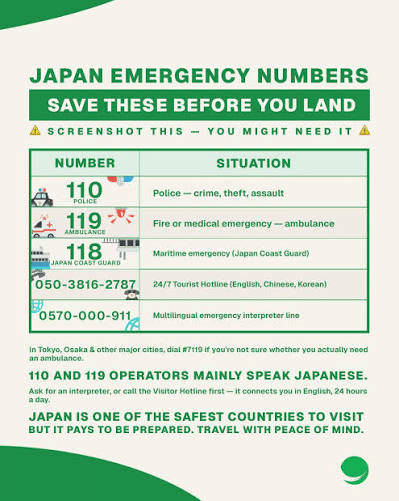
Emergency Numbers: Japan’s Essential Contacts
The Three Numbers Every Traveler Should Know
110 — Police (Keisatsu)
Call 110 when you need the police for a crime, traffic accident, or other public safety emergency. When you call, the system connects you with the police dispatch service responsible for the area where you are.
Language support: Japan’s police emergency system provides English support in many major urban and tourist areas. However, English availability can vary by location, particularly in rural areas. For this reason, keeping a translation app such as Google Translate ready can help you communicate if the dispatcher cannot speak English.
Connectivity requirement: You do not normally need mobile data to make an emergency call to 110. Many smartphones can make emergency calls even without an active SIM or with a foreign SIM. Nevertheless, a working data connection can make communication easier after the initial call because you can use translation tools and access location information.
119 — Ambulance and Fire (Kyuukyu/Shoubousha)
Call 119 for medical emergencies, fires, and rescue situations. Similarly, the call connects you with the local fire and emergency medical services responsible for your location.
Language support: English support may be available, particularly in major cities and tourist areas, but availability can vary. Therefore, travelers who do not speak Japanese should keep a translation app available whenever possible. In addition, multilingual medical-support services can provide useful assistance when you need help navigating Japan’s healthcare system.
JHelp (Japan Helpline)
JHelp provides 24-hour assistance for foreigners in Japan. Unlike 110 and 119, it focuses on non-emergency situations and general assistance rather than immediate police, fire, or ambulance response.
For example, travelers can use a helpline service when they need guidance about a problem that does not require an immediate emergency response. In situations where language creates a barrier, such services can also help travelers understand which type of assistance they need and where to seek it.
As a result, knowing the difference between emergency numbers and non-emergency assistance services helps travelers choose the right resource quickly when something goes wrong.
Earthquake Apps: Safety Tips and Japan-Specific Resources
Safety Tips App (Japan Tourism Agency)
The official japan earthquake app recommended by the Japan Tourism Agency — Safety Tips — is designed specifically for foreign visitors to Japan and provides:
Push alert delivery: The app delivers Japan’s official earthquake early warning system alerts (J-Alert) in English and multiple Asian languages. These alerts arrive before the strongest shaking from a distant earthquake — sometimes 5–30 seconds of warning depending on the earthquake’s distance.
Multilingual disaster information: Shelter locations, evacuation advisories, and disaster status updates in multiple languages.
No Japanese reading required: The app is designed for foreign visitors who cannot read Japanese emergency communications.
Data requirement: The app requires data connectivity for setup and for receiving alerts. Japan’s emergency alert system can also push basic alerts to mobile phones via a carrier-level system (Cell Broadcast) that doesn’t require data — a Japan Sim Data eSIM active on Japanese carrier networks receives these carrier-level alerts automatically.
Download before departure: Available in iOS App Store and Google Play. Download over WiFi before departure to ensure it’s available immediately on arrival.
J-Alert System: Carrier-Level Alerts
Japan’s J-Alert (全国瞬時警報システム) sends emergency alerts — earthquake early warnings, tsunami warnings, and missile/security alerts — directly to mobile phones through carrier broadcast systems without requiring data or internet access. These alerts appear automatically on any phone connected to a Japanese carrier network.
Japan esim safety advantage: A Japan Sim Data eSIM on Docomo, SoftBank, or KDDI connects your phone to Japan’s carrier networks — including the J-Alert broadcast system. A traveler whose phone is connected only to foreign carrier roaming may or may not receive these carrier-level alerts depending on the roaming configuration. A direct Japanese carrier eSIM connection receives them reliably.
The alert presents as a loud alarm regardless of phone settings (similar to the loud emergency alert sound in many countries) with Japanese text. The Safety Tips app provides the English-language version of the same alert content.
Typhoon Apps: Monitoring and Response
Japan Meteorological Agency (JMA) App
The authoritative typhoon tracking app — the same data source used by Japan’s infrastructure operators, transportation companies, and government agencies. JMA provides:
Typhoon track forecasts: Updated every three hours during active typhoon watch, more frequently near landfall
Rainfall and wind intensity maps: Prefecture-level severe weather predictions
Evacuation advisories: When JMA issues evacuation recommendations for specific areas, the app reflects this information
Data requirement: Live data for real-time forecast updates. This is a continuous monitoring function during typhoon season — the Japan Sim Data eSIM provides the connectivity for checking conditions throughout a weather event.
NHK World
Japan’s English-language international broadcaster provides typhoon coverage, earthquake follow-up reporting, and general Japan news accessible to non-Japanese speakers. During severe weather events, NHK World’s coverage in English provides context and guidance that Japanese-only broadcasts don’t offer to international visitors.
Data requirement: Live data for app streaming and article access.
Weather News (Weathernews)
Japan’s most popular commercial weather app — with rain radar, typhoon tracking, and hourly forecast updates. More visually intuitive than JMA for day-to-day monitoring, particularly the rain radar that shows approaching weather fronts in real time.
Medical Translation and Hospital Finder Tools
AMDA International Medical Information Center
The Association of Medical Doctors of Asia (AMDA) operates a multilingual medical consultation phone line for foreign visitors to Japan:
AMDA phone: 03-5285-8088 (Tokyo-based; hours vary — check current operating hours)
AMDA provides:
- Medical terminology translation assistance
- Guidance on navigating Japan’s medical system
- Hospital and clinic referral for specific medical needs
- Support for insurance-related medical documentation
Access method: Phone call — requires either local phone call capability (possible through VoIP over Japan eSIM data) or a Japan carrier phone number. Alternatively, the website (amdamedicalcenter.com) provides information accessible over data.
Japan Hospital Finder Apps and Resources
japan esim medical hospital search: Google Maps provides the most practical hospital and clinic finder for travelers — search “hospital near me” or “emergency hospital Tokyo” (substituting your location) for a mapped list of nearby medical facilities with hours and contact information. Requires live data.
JNTO’s Medical Information: The Japan National Tourism Organization provides a medical institution search on its official website (jnto.go.jp) with English-language information about hospitals serving international patients. Data access required.
MedicalFinder: A Japan-specific medical facility search that indicates English-speaking staff availability — useful for identifying hospitals where communication will be most straightforward for international visitors. Data required.
Medical Translation Apps
Google Translate: For in-facility communication with Japanese-speaking medical staff. The camera function translates written information (admission forms, discharge instructions, medication labels). The conversation function enables real-time spoken translation. Data required for camera and conversation functions.
VoiceTra: A government-supported multilingual voice translation app specifically designed for healthcare communication in Japan — supporting 31 languages. Data required.
How Reliable Mobile Data Supports Emergency Response

The Data-Emergency Connection
The practical value of japan esim safety connectivity in emergency scenarios:
Earthquake: After shaking stops, the immediate priorities are: confirm safety of travel companions (messaging), check J-Alert or Safety Tips app for aftershock warnings and evacuation advisories (data), locate nearest evacuation point on Google Maps (data), contact accommodation about building safety (call or data). Every function except the initial carrier-level alert benefits from live data.
Medical emergency: Locating the nearest hospital (data), navigating to that hospital (data), communicating with emergency services (translation apps need data for camera function), contacting travel insurance (data or call), reaching family with updates (messaging over data).
Typhoon disruption: Monitoring typhoon track (data for JMA), checking transport suspension status (data for JR and airline apps), rebooking accommodation or transport (data for booking platforms), communicating with family (messaging over data), checking JMA’s evacuation advisories (data).
Getting lost or stranded: Navigation back to familiar areas (data for Google Maps), communication with accommodation about delayed return (messaging over data), locating a convenience store or safe public space (data for maps).
In each scenario, data connectivity transforms a challenging situation into a manageable one. The absence of connectivity in the same scenarios doesn’t prevent survival — Japan’s safety infrastructure is robust — but it removes the information tools that significantly affect the quality of the response.
docomo emergency Network Advantage
The japan esim data safety dimension of carrier selection: Docomo’s carrier-level emergency infrastructure — including the most extensive J-Alert broadcast coverage in rural areas — reflects the national carrier’s obligations to Japan’s emergency communication system. For travelers in rural or mountain areas, Docomo’s broader coverage ensures that both J-Alert push notifications and regular data-dependent safety apps function in the locations furthest from urban emergency services infrastructure.
Japan Sim Data Traveler Recommendations
Pre-Trip Safety App Installation
Install all emergency and safety apps before departure over home WiFi:
- Safety Tips (Japan Tourism Agency official emergency app)
- NHK World (English emergency broadcasting)
- JMA Weather (official typhoon and severe weather)
- Google Translate with Japanese offline pack (medical translation offline capability)
- Your country’s embassy in Japan app or website — bookmark the emergency contact page
Configure Safety Tips to enable push notifications before arriving in Japan — some notification settings require device configuration that is easier to complete before the alert system is needed.
Plan Sizing for Safety-Conscious Travelers
The japan esim traveler safety data planning consideration: emergency scenarios consume moderate data for their most critical functions (receiving alerts, checking maps, messaging family) but can extend to higher data use if rebooking, researching medical facilities, and communicating with insurance companies over an extended disruption period.
For typhoon season travelers (August–September) and travelers in earthquake-active regions, a data plan with buffer above normal estimated consumption — or an unlimited plan — provides confidence that a disruption event won’t coincide with data exhaustion.
According to the Japan National Tourism Organization (JNTO), emergency preparedness information for international visitors is a priority area, with JNTO’s Safety Tips app identified as the recommended primary emergency information resource for foreign visitors. The GSMA, notes that emergency connectivity through local carrier networks is identified as a significant eSIM adoption driver in destinations with natural disaster exposure — Japan specifically cited as a market where direct carrier eSIM connection’s J-Alert compatibility provides a meaningful safety benefit over foreign carrier roaming alternatives.
Conclusion: Your eSIM Is Your Safety Net
Japan is safe. The extraordinary rare occurrence of violent crime, the culture of collective helpfulness, the exceptional emergency service infrastructure — these are real and accurate characterizations of Japan’s safety environment that legitimately distinguish it from most international travel destinations.
Japan is also seismically active, typhoon-prone, and subject to weather events that disrupt travel in ways that require information access and real-time response. The intersection of Japan’s genuine safety with these natural event realities makes a data-connected phone not a luxury but the information infrastructure through which Japan’s own safety systems deliver their value to international visitors.
A Japan Sim Data eSIM on a Japanese carrier network — receiving J-Alert notifications automatically, enabling Safety Tips app, providing the data for medical translation and hospital location, and supporting the communication with family and insurance that emergency situations require — is the connectivity layer that makes Japan’s safety infrastructure accessible to travelers in their own language.
Install Safety Tips before departure. Know 110 and 119. And trust that the Japan Sim Data eSIM you’ve configured correctly is working quietly in the background, ready to become your most important Japan travel tool if the situation requires it.
Available at https://japansimdata.com/
Frequently Asked Questions
Q1: What are Japan’s emergency phone numbers?
A: 110 for police; 119 for ambulance and fire. Both function without data and are accessible even without an active SIM on most smartphones. The Japan Helpline (+81-570-000-911) provides 24-hour multilingual assistance for non-emergency situations requiring language support.
Q2: Will I receive Japan’s earthquake early warning alerts on a Japan eSIM?
A: Yes. Japan’s J-Alert earthquake early warning system broadcasts through carrier networks to all phones connected to Japanese carrier networks. A Japan Sim Data eSIM on Docomo, SoftBank, or KDDI connects your phone to these carrier broadcasts — alerts arrive as loud push notifications regardless of phone sound settings, even without the Safety Tips app installed.
Q3: Is the Safety Tips app free and in English?
A: Yes. Safety Tips is a free app published by the Japan Tourism Agency, available in English and multiple Asian languages, providing earthquake alerts, typhoon warnings, evacuation advisories, and disaster information for foreign visitors in Japan. Download it before departure at the App Store or Google Play.
Q4: How do I get medical help in Japan if I don’t speak Japanese?
A: AMDA International Medical Information Center (03-5285-8088) provides multilingual medical support by phone. Google Translate’s camera function translates medical forms and documents. Google Maps identifies nearby hospitals. JNTO’s medical institution search identifies hospitals with English-speaking staff. Your Japan Sim Data eSIM provides the data connectivity for the app and research functions that make these resources accessible.
Q5: Does my Japan eSIM carrier affect emergency alert reception?
A: All three Japan Sim Data carriers (Docomo, SoftBank, KDDI) participate in Japan’s J-Alert emergency broadcast system. The coverage difference between carriers for emergency alerts follows the same pattern as general coverage — Docomo’s broader rural coverage means carrier-level emergency alerts reach a wider geographic range on Docomo, making it the preferred network for travelers in rural, mountain, or remote areas.