

Japan eSIM Coverage Where It Counts: Shinkansen, Hokkaido, the Japanese Alps and Okinawa
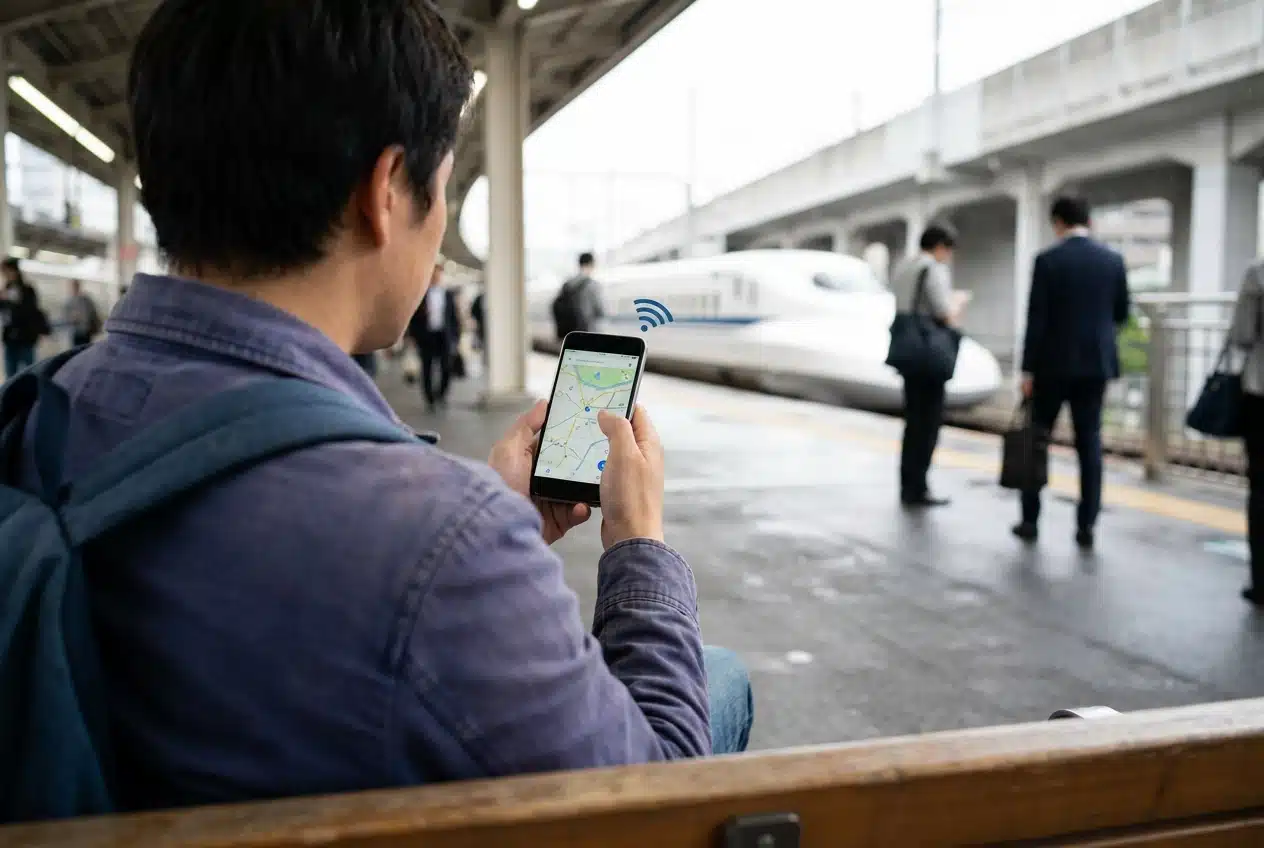
Picking an eSIM for Japan travel sounds straightforward until you leave Tokyo and the coverage picture gets complicated fast. Japan’s four carriers operate networks with dramatically different rural footprints, and the plan you choose before departure is quietly also a coverage decision that will define your connectivity across some of the country’s most demanding terrain.
This analysis stress-tests real-world signal where travellers worry most: the Shinkansen corridors that demand continuous data at 320 km/h, the rural depths of Hokkaido, the high-altitude passes of the Japanese Alps, and the scattered outer islands of Okinawa. Coverage in Japan’s major cities is universally reliable, so that is not the focus here. What matters is understanding how NTT Docomo, SoftBank, au/KDDI, and Rakuten Mobile each perform when the landscape turns mountainous, remote, or island-bound.
Because Japan Sim Data plans run explicitly on either Docomo or SoftBank infrastructure, knowing each network’s strengths translates directly into choosing the right plan for your specific route. By the end of this piece, you will have a clear, itinerary-level framework for making that decision with confidence.
Why Your eSIM Plan Choice Is Also a Coverage Decision
When purchasing an eSIM for Japan travel, most travellers focus on data volume and plan duration. The more consequential variable is frequently overlooked: which mobile network the plan routes through. For the majority of eSIM products sold for use in Japan, the host network is determined at the point of purchase; consult individual plan terms for any post-activation options.
Japan operates four national mobile carriers: NTT Docomo (approximately 36–40% market share), KDDI/au (26–31%), SoftBank (27–28%), and Rakuten Mobile (8–10%). Each operates a materially different network infrastructure, and those differences are negligible in Tokyo or Osaka but significant once an itinerary moves beyond major cities.
Urban coverage across all four carriers is broadly reliable for standard travel applications: navigation, messaging, translation, and ride-hailing. The meaningful divergence emerges in four specific corridors that travellers to Japan most frequently identify as connectivity concerns: Hokkaido’s rural interior, the Japanese Alps, the Tohoku countryside, and Okinawa’s outer islands. In those regions, network choice directly determines whether connectivity is dependable or intermittent.
Japan Sim Data discloses the host network on every plan page, a transparency that converts what is typically an opaque purchase into an informed itinerary decision. Plans run on either NTT Docomo or SoftBank; for example, a Japan eSIM 12-day plan on the SoftBank network is well suited to urban-focused itineraries where SoftBank’s strong city coverage is an advantage.
This analysis examines each of the four high-concern corridors in detail and maps those findings to the Docomo or SoftBank plan decision, rather than restating the generic nationwide coverage claims that characterise most eSIM product descriptions.
Japan’s Four Carriers: Coverage Profiles at a Glance
The differences between Japan’s four carriers emerge most clearly once an itinerary moves beyond the major cities. The table below maps each carrier across the metrics that matter most for travellers to Japan choosing a data plan.
| Carrier | Market Share | Rural/Mountain Strength | Outer Island Strength |
|---|---|---|---|
| NTT Docomo | ~36–40% | Strongest | Strongest |
| KDDI/au | ~26–31% | Strong | Moderate |
| SoftBank | ~27–28% | Weaker outside major cities | Limited |
| Rakuten Mobile | ~8–10% | Significant gaps | Minimal |
NTT Docomo holds approximately 92 million subscribers and leads 5G population coverage. Its primary advantage for Japan travel is network depth: extensive infrastructure supports more consistent signal in valleys and mountainous terrain. This translates directly to more consistent connectivity in Hokkaido’s interior, the Japanese Alps and the Okinawa outer islands.
KDDI/au is distinguished by its investment in small-cell infrastructure at select resort and mountain facilities. Where macrocell towers cannot serve ski lifts, mountain huts or trailhead facilities, targeted small-cell deployments fill the gap. This makes KDDI/au particularly relevant for resort-focused itineraries, though its general rural footprint remains narrower than Docomo’s.
SoftBank is a capable choice for city-concentrated travel. Its 10-day SoftBank plan suits itineraries anchored in Tokyo, Osaka or Fukuoka. SoftBank’s network is optimised for urban environments; coverage outside major cities and prefectural capitals is less extensive than Docomo’s, which matters for any route that extends into the countryside.
Rakuten Mobile’s coverage remains concentrated in urban areas, with significant gaps in rural prefectures; it is not relevant to most inbound travel eSIM products.
In designated 5G zones, realistic speeds across all carriers reach 200–500 Mbps. Beyond those zones, LTE delivers a practical 50–100 Mbps, which is sufficient for navigation, translation and ride-hailing throughout most Japan travel itineraries.
Shinkansen Corridor Coverage: Staying Connected at 320 km/h
Those carrier-level differences translate directly to the Shinkansen, where tunnels, not distance, are the primary connectivity challenge.
Japan’s high-speed rail network passes through hundreds of tunnels, some extending several kilometres, and signal continuity depends on in-tunnel repeater infrastructure rather than outdoor base station density. Japan’s major carriers have invested in in-tunnel infrastructure along high-traffic Shinkansen lines; signal resumes automatically on tunnel exit via LTE fallback, so brief interruptions rarely affect practical use cases such as messaging or map navigation.
SoftBank coverage is generally stronger along the heavily populated Tokaido corridor (Tokyo to Osaka to Hakata). Travellers on the Tohoku and Hokkaido Shinkansen, where the supporting terrestrial network is thinner, should check current coverage maps before selecting a SoftBank-based plan.
The Hokkaido Shinkansen presents the most demanding scenario. The line’s defining infrastructure challenge is the undersea Seikan Tunnel connecting Honshu to Hokkaido. Beyond the tunnel, the line approaches Shin-Hakodate-Hokuto through low-density rural terrain. Docomo’s extensive network infrastructure provides the most consistent signal across both the undersea segment and the Hokkaido approaches.
For travellers to Japan holding a JR Pass or booking point-to-point tickets across multi-leg itineraries, such as Tokyo to Sapporo or Tokyo to Kanazawa continuing onward, a Docomo-based eSIM plan offers the most reliable signal continuity across the full journey. A 15-day plan on the SoftBank network suits urban-focused travel but is less appropriate where the itinerary extends through northern corridors.
Note that unlimited plans are subject to fair-use and speed-management conditions; sustained video streaming at speed may trigger throttling under those terms.
Hokkaido: Where Rural Coverage Gaps Are Real
The connectivity challenge that begins at the Seikan Tunnel does not end at Shin-Hakodate-Hokuto; once travellers enter Hokkaido proper, the coverage picture becomes more demanding.
Hokkaido is Japan’s largest prefecture by land area at 83,424 km², yet its population density sits at approximately 68 people per km², roughly one-fifth of Japan’s national average. That sparse settlement translates directly into uneven mobile infrastructure. Sapporo, Otaru, Niseko, Furano and Biei carry reliable multi-carrier coverage. The interior and eastern regions tell a different story: the Shiretoko Peninsula, Lake Akan and the Tokachi plain expose material gaps on SoftBank and Rakuten, where base station density does not justify the infrastructure investment.
For any itinerary extending beyond the main tourism corridors, a Docomo-based plan is the practical choice. Self-drive routes across the central highlands, cycling tours through the Furano-Biei countryside and rail journeys on the Soya and Senmo Lines all traverse areas where SoftBank coverage becomes intermittent and Rakuten coverage is largely absent.
The alpine resort picture requires a separate note. KDDI/au’s investment in small-cell infrastructure performs well at ski lifts and mountain accommodation in Niseko and the Daisetsuzan area, making it reasonable for resort-only stays. Travellers combining a ski visit with broader countryside travel will find a Docomo-based plan covers more of the combined itinerary consistently.
Activation timing matters more here than in urban Japan. Travellers arriving at New Chitose Airport and proceeding directly to rural destinations should install and activate their eSIM on landing, or before departure. Japan Sim Data eSIMs are delivered by QR code and can be installed in advance; consult individual plan terms on japansimdata.com for when the validity period begins. Do not wait until rural gaps are already relevant. A 9-day plan on the SoftBank network suits Sapporo-centric itineraries; for routes moving into the interior, select a Docomo-based equivalent at purchase.
Winter travel adds a further variable. Heavy snowfall and sub-zero temperatures affect macrocell signal propagation. Docomo’s larger nationwide network footprint is generally regarded as providing more consistent rural coverage under these conditions than smaller-footprint carriers.
The Japanese Alps: Signal in High-Altitude and Remote Terrain
Valley topography, elevation, and limited infrastructure access combine to stress-test all carrier networks across the Northern Alps (Hakuba, Kamikochi, Tateyama-Kurobe), the Central Alps, and the Southern Alps.
At the village level, the picture is reasonably clear. Hakuba’s valley floor and main resort facilities carry both Docomo and KDDI/au signal under normal conditions. Above the treeline, coverage becomes patchy across all carriers; Docomo maintains the broadest footprint at village and mid-mountain elevations, supported by its extensive network infrastructure.
Kamikochi requires specific attention. Private vehicles are prohibited; access is by bus or taxi only. Signal conditions inside the Kamikochi valley are variable; download offline maps before entering regardless of carrier. Japan eSIM plan holders should complete this step before boarding the bus into the valley.
Where KDDI/au distinguishes itself in the Alps is at targeted infrastructure points. Its investment in small-cell infrastructure at mountain huts and ski resort facilities provides coverage at select points where macrocell signal does not reach. For itineraries built around ski touring in Hakuba or hiking defined resort-linked routes, a plan running on KDDI/au may serve those specific locations better than a Docomo-based alternative.
Travellers on the Tateyama-Kurobe Alpine Route should check Docomo’s coverage map for specific transit points; underground cable car and tunnel segments will have no signal from any carrier.
Conflicting user reports from the Kisogawa valley and Kamikochi interior are consistent with localised alpine signal variability rather than carrier-wide failures. These represent geographic pockets where valley walls and elevation attenuate all signals. They do not contradict the broader finding: across the Japanese Alps as a whole, Docomo holds the widest rural network coverage at village and approach-trail levels.
Okinawa Main Island and the Outer Islands: Which Network Holds?
The alpine coverage challenges above are specific to terrain and elevation. Okinawa presents a different constraint: geographic dispersal across dozens of inhabited islands separated by open water, where network investment follows population density and ferry routes rather than mountain topography.
On the main island, coverage is not a concern. Naha, Chatan, Onna-son and Nago all carry reliable signal from both Docomo and SoftBank, giving travellers adequate connectivity for navigation, translation and transport.
The calculation changes on the outer islands. Docomo is generally recognised as having the wider coverage footprint across Japan’s remote island chains. Travellers to outer Okinawa islands should verify current coverage via official carrier maps before selecting a plan. For any itinerary moving beyond the main island, a Docomo-based eSIM is the appropriate choice.
Island-hopping routes amplify this difference. Travellers moving from Ishigaki to Iriomote, Taketomi or Hateruma-jima will find Docomo the more reliable option at each stop. A 13-day SoftBank plan suits the main island, but travellers extending into the outer Yaeyama Islands should select a Docomo-based alternative.
Cruise passengers arriving at Naha or Ishigaki port can expect Docomo-based plans to connect on disembarkation. Ferry crossings will produce variable signal; distance from shore and vessel position both affect continuity, and brief gaps should be anticipated regardless of carrier.
No carrier provides signal underwater. Surface connectivity between dive sites is well served by a Docomo-based eSIM.
| Island / Location | Docomo | SoftBank | Notes for Travellers |
|---|---|---|---|
| Okinawa Main Island (Naha, Chatan, Nago) | Recommended | Recommended | Both networks adequate throughout |
| Kerama Islands (Zamami, Tokashiki) | Recommended | Check carrier map | Verify SoftBank coverage beyond port areas |
| Miyako-jima | Recommended | Check carrier map | Verify SoftBank rural and coastal coverage |
| Ishigaki-jima | Recommended | Check carrier map | Docomo recommended for full island travel |
| Iriomote-jima | Check carrier map | Check carrier map | Download offline maps before arrival |
| Taketomi-jima | Recommended | Check carrier map | Docomo functional for navigation |
| Hateruma-jima | Recommended | Check carrier map | Verify coverage before travel to Japan’s southernmost island |
| Ferry crossings | Variable | Variable | Signal interruptions expected mid-crossing |
Docomo vs SoftBank Plans on Japan Sim Data: How to Choose
The regional analysis above establishes a consistent finding: where an itinerary extends beyond Japan’s major cities, the host network behind an eSIM plan becomes a material variable. Japan Sim Data discloses the host network on each plan page, so the selection between a Docomo-based or SoftBank-based plan is a transparent coverage decision made before purchase.
The practical guidance distils as follows:
- Choose a Docomo-based plan for any itinerary that includes rural Hokkaido, the Japanese Alps, the Tohoku countryside, Okinawa’s outer islands, or multi-leg Shinkansen journeys on the Tohoku and Hokkaido lines. Docomo’s extensive network infrastructure provides the broadest footprint in precisely the corridors where connectivity risk is highest.
- Choose a SoftBank-based plan for itineraries concentrated in major urban centres: Tokyo, Osaka, Kyoto, Nagoya, and Fukuoka. SoftBank’s strong urban coverage is a genuine advantage in those environments, and the rural gaps documented in earlier sections are not a concern for city-focused travel. For reference, a 30-day SoftBank-based eSIM with daily high-speed data allocation illustrates the plan structure available for longer urban stays.
Both networks carry fixed-data plans ranging from 1 GB to 50 GB, and unlimited plans spanning 3 to 30 days. Unlimited plans are subject to fair-use and speed-management conditions after a defined usage threshold; review individual plan terms before purchase, particularly if the itinerary involves sustained video streaming or group tethering.
Two purchase conditions apply regardless of network choice. First, all Japan Sim Data eSIMs are data-only: they carry no Japanese phone number, no voice calls, and no SMS, and cannot receive verification codes for LINE, Japanese banking applications, or other SMS-dependent services. Travellers requiring those functions will need a separate solution. Second, the device must be eSIM-capable and carrier-unlocked; compatibility should be confirmed before purchase. Japan Sim Data’s installation guides address the activation process for both iOS and Android devices.
For Travel Agencies, Tour Operators and DMCs: Planning Coverage by Itinerary
The individual plan decision covered in the preceding section has a direct parallel at the organisational level. For travel agencies, tour operators, DMCs, MICE managers, study-abroad programmes and relocation firms, network selection should be treated as an itinerary variable built into programme design, not a single default purchase applied uniformly across a group.
Coverage as an itinerary variable
As detailed in the regional sections above, Docomo-based plans are appropriate for itineraries including rural Hokkaido, the Alps, Tohoku or Okinawa’s outer islands.
Group provisioning through Japan Sim Data
Japan Sim Data provides bulk and agency pricing with group provisioning, QR-code delivery at scale and invoiced billing in JPY or USD. This removes the logistics burden of sourcing physical SIM cards, arranging airport pickup, or managing individual retail purchases across a group. Agency terms are written for Japanese inbound trade practice. Enquiries can be directed to the bulk and agency page at japansimdata.com.
For reference, the Japan eSIM 11-day plan running on the SoftBank network illustrates the plan structure available to urban-itinerary clients, with the host network clearly disclosed at the point of selection.
MICE, corporate travel and extended-stay programmes
MICE and corporate travel managers whose delegates attend events in Tokyo or Osaka with optional pre- or post-touring in rural areas should document the host network decision in travel packs before departure. For study-abroad programmes at universities outside major cities, a Docomo-based plan is generally the safer choice given Docomo’s wider national footprint. Relocation firms and internship coordinators can recommend Docomo-based long-stay eSIM plans to new arrivals travelling outside major cities during the initial settlement period, before a domestic SIM contract is in place.
Fair-Use Policies, Tethering and Seasonal Considerations
Beyond itinerary and network selection, several operational variables affect connectivity in practice.
Fair-Use and Speed Management
Unlimited eSIM plans are subject to fair-use policies across all host networks in Japan. After a defined high-speed data threshold is reached, speeds may be reduced for the remainder of the billing period. Reduced speeds support navigation, messaging and map loading, but will impair sustained video streaming or large file transfers. This applies universally to unlimited eSIM products. Review individual plan terms before purchase.
Tethering
Check individual plan terms on japansimdata.com for tethering availability and any applicable data allocation limits. Groups should not rely on a single eSIM shared across multiple devices, particularly in rural Hokkaido or alpine areas where a shared hotspot compounds bandwidth constraints. For a city-focused itinerary, a 14-day SoftBank plan with 2GB of daily high-speed data offers a fixed-data structure that makes per-device usage straightforward to manage.
Seasonal Coverage Variables
Heavy snowfall in Hokkaido and the Japanese Alps during winter can temporarily affect base station availability. Docomo’s larger nationwide network footprint is generally regarded as providing more consistent rural coverage under these conditions. Severe weather during typhoon season can temporarily disrupt connectivity on outer islands regardless of carrier; this is an infrastructure reality, not a plan-specific limitation.
High-altitude destinations including the Tateyama-Kurobe Alpine Route and Kamikochi operate on seasonal schedules. Confirm access dates before activating an eSIM. Japan Sim Data eSIMs are delivered by QR code and can be installed on your device before travel; consult individual plan terms on japansimdata.com for when the validity period begins.
Peak Period Congestion
Network congestion during Golden Week, Obon, Niseko ski season and cherry blossom season in Kyoto may reduce speeds on all carriers. This reflects shared infrastructure demand across Japan’s tourism calendar and is not attributable to any specific plan or network.
Frequently Asked Questions: Japan eSIM Coverage
Q: Which eSIM network is best for rural Japan and the Japanese Alps?
NTT Docomo has the broadest rural coverage footprint in Japan, including Hokkaido’s interior, mountain regions such as Hakuba and Kamikochi, and Okinawa’s outer islands. For any itinerary that extends beyond Japan’s major cities, a plan running on Docomo is generally the more appropriate choice.
Q: Does an eSIM for Japan work on the Shinkansen?
Yes. Docomo-based plans maintain coverage along most Shinkansen corridors. Brief signal loss occurs in longer tunnels but resumes automatically on exit. SoftBank coverage is generally stronger along the heavily populated Tokaido Shinkansen (Tokyo to Hakata); travellers on the Tohoku and Hokkaido Shinkansen should check current coverage maps before selecting a SoftBank-based plan.
Q: Will an eSIM work in Okinawa’s outer islands such as Miyako-jima or Hateruma?
A Docomo-based eSIM plan provides the most reliable coverage across Okinawa’s outer islands. For island-hopping itineraries in the Ryukyu chain, verify current coverage via official carrier maps; Docomo is generally the recommended choice.
Q: Can I use a Japan eSIM for tethering or as a mobile hotspot?
Check individual plan terms on japansimdata.com for tethering availability and any applicable data allocation limits. On unlimited plans, fair-use conditions apply and tethering may be subject to a separate data allocation or speed limits.
Q: Does a Japan eSIM provide a Japanese phone number or allow me to receive SMS?
Japan Sim Data eSIMs are data-only; they do not include a Japanese phone number, voice calls or SMS, and cannot receive verification codes for LINE, Japanese banking apps or other SMS-dependent services. Travellers requiring those functions will need a separate solution.
Q: When should I activate my Japan eSIM?
Japan Sim Data eSIMs are delivered by QR code and can be installed on your device before travel. Consult individual plan terms on japansimdata.com for when the validity period begins.
Choosing the Right Japan eSIM Plan for Your Route
The preceding FAQs address specific scenarios; the decision framework below consolidates those findings into a single purchase principle.
Network choice in Japan is an itinerary decision. Urban centres, including Tokyo, Osaka, Kyoto and Fukuoka, return reliable coverage on any carrier, making plan selection there largely a question of data volume and duration. Beyond the cities, the Docomo-vs-SoftBank framework established earlier in this piece applies directly: Docomo for rural and remote corridors, SoftBank where urban speed is the priority.
Japan Sim Data discloses the host network on each plan page, so that decision is reviewable before checkout.
For individual travellers: visit japansimdata.com to browse fixed-data and unlimited plans across both networks, matched to your itinerary length and data requirements.
For travel agencies, tour operators and DMCs: group provisioning, invoiced billing in JPY or USD, and QR-code delivery at scale are available through the bulk and agency page at japansimdata.com. Coverage planning should be treated as a line item in client documentation, particularly for itineraries that combine urban and rural Japan in a single package.
For data-only and fair-use reminders, see the plan terms section above.
Conclusion
Japan’s connectivity landscape is more varied than most travellers expect. The right eSIM plan depends not just on data volume but on which network underlies it, because Docomo and SoftBank serve different geographies with meaningfully different results. Docomo-based plans cover the Shinkansen corridors, Hokkaido’s rural stretches, the Japanese Alps, and Okinawa’s outer islands with the most reliability. SoftBank-based plans deliver strong performance where urban speed matters most.
Before you purchase, match your plan to your actual route. Japan Sim Data shows host networks upfront, so that decision is never a guess.
Visit japansimdata.com to find the plan that fits your itinerary, your data needs, and the terrain you intend to cross. The right coverage decision made before departure means fewer interruptions and more time focused on the journey itself.